

There’s a particular kind of frustration that comes from asking ChatGPT a legal question and watching it confidently explain a principle that doesn’t exist in Australian law.
Will McCartney knows this well. The University of Sydney law student turned dropout founded Habeas in 2023 after realising that generic AI tools were actively dangerous for Australian legal practice. They’d surface US precedents when you needed Australian ones. They’d cite cases that sounded right but weren’t. And they’d do it all with the unshakeable confidence that makes AI hallucinations so insidious.
So he built something different. Habeas is trained exclusively on over 300,000 Australian legal documents: case law, legislation, statutes, and other public legal sources. It doesn’t guess at Australian law based on what American courts might do. It retrieves, verifies, then reasons.
The RSV Framework: Why Most Legal AI Fails
Most AI tools work backwards. They generate an answer first, then try to find sources that support it. This is how you get hallucinated citations: the model produces something that sounds authoritative, then reverse-engineers justification.
Habeas inverts this with what I call the RSV approach: Retrieve, Search, Verify.
- Retrieve relevant documents from the Australian legal corpus first
- Search for specific passages that address the query
- Verify every assertion against actual citations before presenting
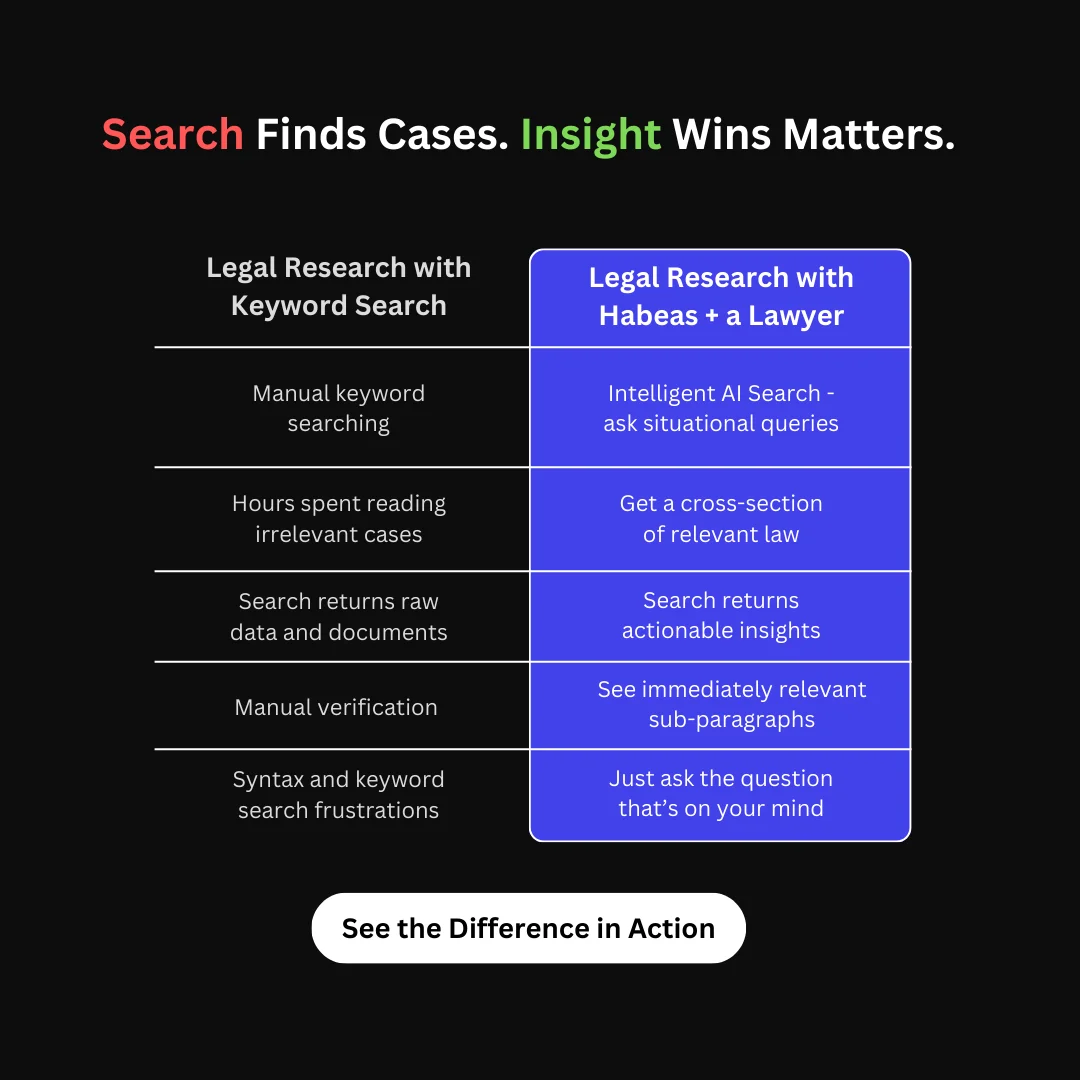 Habeas uses semantic search to find relevant cases even when they use different terminology. Source: Habeas
Every assertion the platform makes is backed by specific citations to paragraphs within judgments or legislation. You can click through and verify. If it can’t find authority, it doesn’t make the claim.
This matters because Australian lawyers don’t just need speed. They need accuracy. A missed precedent can be devastating. A fabricated one can be career-ending.
The Keyword Problem: Why Traditional Search Falls Short
Here’s a framework for understanding why traditional legal databases struggle:
Keyword search = You type “unconscionable conduct,” you get documents containing those exact words.
Semantic search = You type “unconscionable conduct,” you get documents about the same legal concept, even if they use different terminology like “unfair dealing” or “exploitation of vulnerability.”
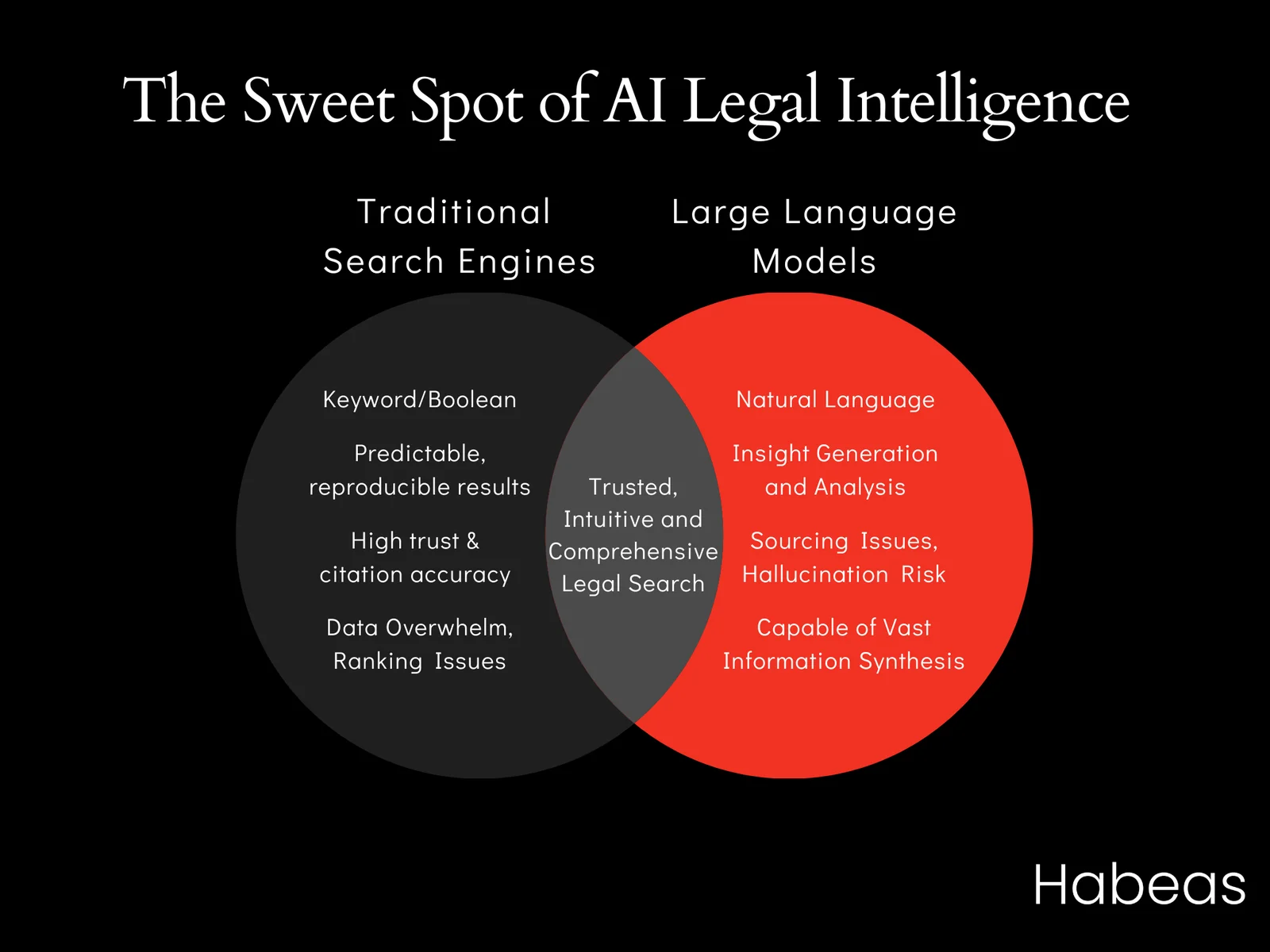 The platform delivers synthesised answers backed by precise citations. Source: Habeas
Traditional legal databases like LexisNexis and Westlaw rely on Boolean search. It works, but it misses context. If you’re researching unconscionable conduct in commercial contexts, keyword search only returns cases using those exact words. Cases that would take hours to discover through manual research appear in seconds with semantic search.
According to firms using the platform, this cuts research time roughly in half. But the more interesting claim is about quality: lawyers report conducting more comprehensive research, not less. They’re uncovering connections and authorities they would have otherwise missed entirely.
The Three Capabilities Model
The platform offers three core capabilities that map to how lawyers actually work:
-
Semantic Search Engine:
Retrieves and summarises relevant case law across publicly accessible Australian legal databases. Finds cases you'd miss with keyword search.
-
Real-Time Q&A:
Ask complex questions in natural language and get immediate, cited answers. Every response includes paragraph-level citations you can verify.
-
Document Upload & Precedent Libraries:
Upload your own briefs and build searchable precedent libraries within specific practice areas. Turns institutional knowledge into searchable data.
This last feature is particularly clever. Upload five years of employment law briefs and you can search over your own cases to find similar patterns. For barristers working tight deadlines between court and chambers, instant access to relevant authorities changes what’s possible.
The Australia-First Advantage
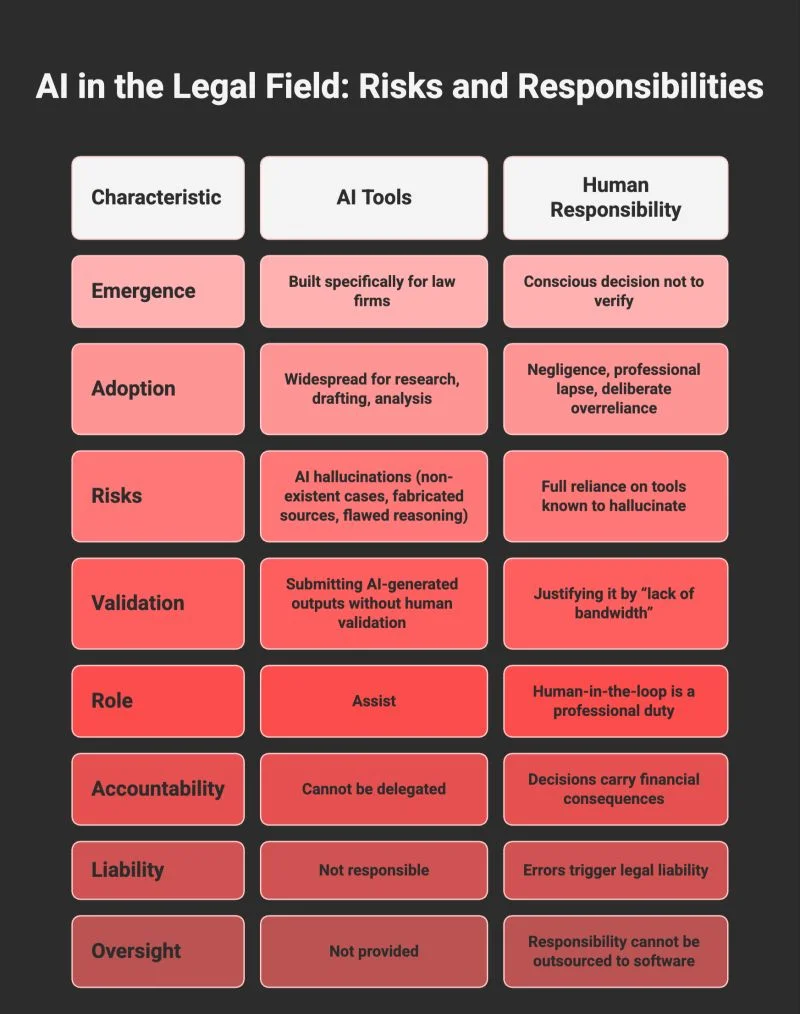 Purpose-built for Australian law, not adapted from international tools. Source: Habeas
International legal AI tools like Harvey (trained primarily on US and UK law) treat Australian jurisdiction as an afterthought. Their models default to legal traditions outside Australia. They might surface relevant material, but the interpretive framework is wrong.
Here’s a simple test I use: The Jurisdiction Check.
Ask any legal AI: “What are the requirements for establishing unconscionable conduct under Australian Consumer Law?”
If it starts talking about US contract law principles or UK equity doctrine without distinguishing Australian statutory provisions, it’s not built for Australian practice.
Habeas is architecturally set up to only provide outputs based on Australian law. State and federal jurisdictions are properly distinguished. Legislation and case law are correctly weighted. The system understands that Australian legal reasoning has its own character.
Will McCartney, in a recent Lawyers Weekly piece, put it this way: lawyers can “finally think like lawyers rather than engineers.” The mechanical work of database search gets automated. The judgment, the legal reasoning, the strategic thinking: that stays human.
Most legal AI tools fail because they guess first and verify later. Habeas inverts this entirely: retrieve the documents, search for specific passages, then verify every assertion against citations. For a profession where a single hallucinated case reference can end a career, that inversion isn't a feature. It's the entire product.
What This Means for Smaller Firms
The democratisation angle matters. I think of it as the Research Equity Problem:
- Large commercial firms: Teams of juniors, expensive database subscriptions, unlimited time
- Sole practitioners: Limited resources, same complexity, tighter deadlines
If Habeas delivers what it claims, faster research, fewer missed authorities, consistent quality regardless of who’s doing the work, it changes the competitive dynamics. A two-partner firm in Parramatta could research as comprehensively as a Collins Street giant.
Pricing reflects this accessibility focus: $125/month for solo practitioners, $200/month for professionals, with enterprise options for larger firms.
Under the hood
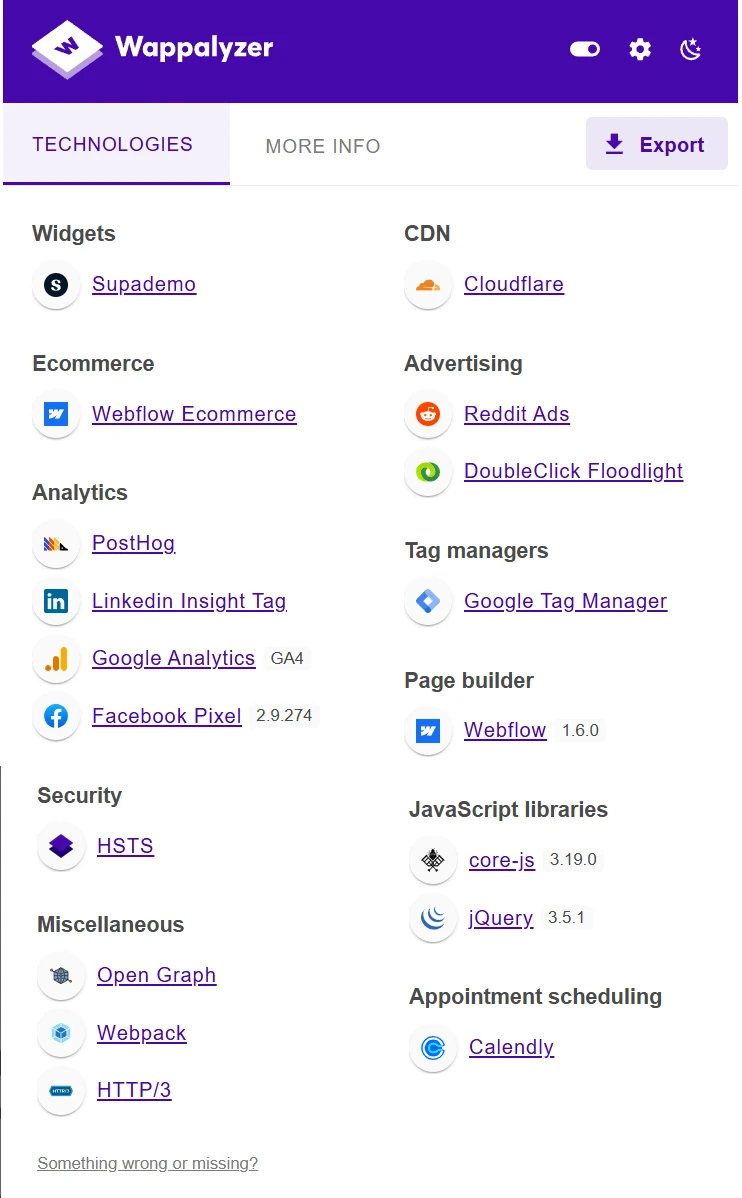 Tech stack captured via Wappalyzer on landing page only.
On the marketing side, Habeas uses Webflow with Cloudflare CDN: a sensible choice for a startup that needs to iterate quickly on messaging. The real engineering lives in the backend: semantic search, retrieval-augmented generation, and citation verification. That’s where their moat is.
Key Takeaways
Law is a profession that rewards scepticism. Every claim gets scrutinised. Every source gets verified. Every argument gets stress-tested.
For legal AI to succeed in this environment, it needs to survive that scrutiny. The citation verification approach, every claim backed by clickable references to specific paragraphs, is designed for exactly this audience. It doesn’t ask lawyers to trust AI. It gives them the tools to verify.
Key takeaways for legal professionals:
-
The RSV test:
Does your AI retrieve and verify before responding, or generate and justify afterwards? The order matters.
-
The jurisdiction check:
Ask a jurisdiction-specific question. If it defaults to US or UK law, it's not built for Australian practice.
-
The citation test:
Can you click through to the actual paragraph being cited? If not, you can't verify.
Whether Habeas delivers on its promises at scale remains to be seen. But the approach, Australian-first, search-first, verification-built-in, addresses the actual objections that legal professionals have to AI tools. Not “will it make me faster” but “will it make me wrong.”
For Australian law firms watching colleagues in the US and UK adopt AI tools that don’t quite fit local practice, Habeas represents a genuinely local alternative. Built in Surry Hills. Trained on Australian law. Designed for how Australian lawyers actually work.
What Habeas shows every other law firm
Habeas is only useful because Will trained it on 300,000 Australian legal documents. That's the whole principle. A model's value scales with the specificity of the context it has. "Law" in general is useful. "Your firm, your matters, your precedents" is transformative.
Generative AI already reads contracts, summarises cases, drafts letters, and answers research questions at the level of a capable paralegal. What it can't do is know your firm's matter types, your house style, your clients, or how your team actually operates.
That's what we do at jopy.agency. We audit the practice and produce structured files: Operations-Model.md, Service-Blueprint.md, Brand-Positioning.md, Customer-Journey.md (to name a few).
What are Structured .md files?
Markdown (.md) is the cleanest and smallest file format that AI likes to read.
We audit businesses end to end, your operations, workflows, brand, customers, tech, etc., then write all of it into structured .md files.
Then you can use these structured .md files so ChatGPT, Claude, Gemini, or any chat-based LLM can read your business context properly for future, in-house vertical growth.
You can then use AI in-house for research, drafting, client updates, internal knowledge management, or whatever gives your firm the most leverage.
Interested in AI Context Auditing? Visit Jopy.agencyInterested in AI Context Auditing?Cite This Article
APA 7THReferences
Formatted in APA 7th Edition
- Lawyers Weekly. (2025). Australian Legal Tech Startup Habeas Cuts Research Time in Half, Firms Report. lawyersweekly.com.au
- Habeas. (2025). Best Australian Legal AI & Legal Research Tool. habeas.ai
- CAUL Open Educational Resources. (2025). Australian Legal AI – GenAI for Legal Practice. oercollective.caul.edu.au
- ALTA. (2023). Habeas - Australian Legal Technology Association. alta.law