Here’s a stat that should make hotel owners uncomfortable: properties with virtual tours see a 14% increase in bookings and 300% more engagement compared to those relying on traditional photography.
Three hundred percent. That’s not an incremental improvement. That’s the difference between a scroll-past and a genuine inspection.
Yet walk through the listings on any major booking platform and you’ll find the majority of Australian hotels, restaurants, and event venues still presenting themselves through static image galleries. Twelve photos arranged in a grid. Maybe a video if they’re feeling adventurous. The same format that worked in 2015.
Meanwhile, their competitors let potential guests walk through the lobby, peek into different room categories, check the view from the rooftop bar, and measure whether the conference room fits their setup requirements. All from a phone in Singapore or a laptop in London.
The 14-300 Rule: Understanding the Engagement Gap
I call this the 14-300 Rule: properties with virtual tours see 14% more bookings and 300% more engagement.
Here’s what that looks like in practice:
| Metric | Photo Gallery | Virtual Tour |
|---|---|---|
| Average session time | ~30 seconds | ~3 minutes |
| Engagement actions | Scroll through | Click, zoom, explore |
| Booking conversion | Baseline | +14% |
| Return visits | Low | High |
Three minutes of active engagement, clicking through rooms, zooming on details, checking different angles, versus thirty seconds scrolling through photos. That’s not passive browsing. That’s genuine consideration.
The Expectation Gap: 2026 vs 2015
Travellers in 2026 expect immersive previews. They’ve used Street View to check out neighbourhoods. They’ve toured apartments without leaving their couch. They’ve experienced virtual reality in gaming and entertainment.
When they’re researching a $400/night hotel stay, a photo gallery feels inadequate. Here’s my SHOW Framework for what travellers actually want to see:
-
S - Space Reality:
What does the room actually look like from the bed? Is it spacious or cramped? Photos can deceive; virtual tours can't.
-
H - Hidden Details:
Is there enough bathroom counter space? Where are the power outlets? What's the closet situation? The details that photos never show.
-
O - Outside Views:
Is the "harbour view" genuinely impressive or technically accurate but mostly wall? Virtual tours reveal what photos strategically hide.
-
W - Walkability:
How does the space flow? What's the journey from elevator to room to restaurant? Context that static images can't convey.
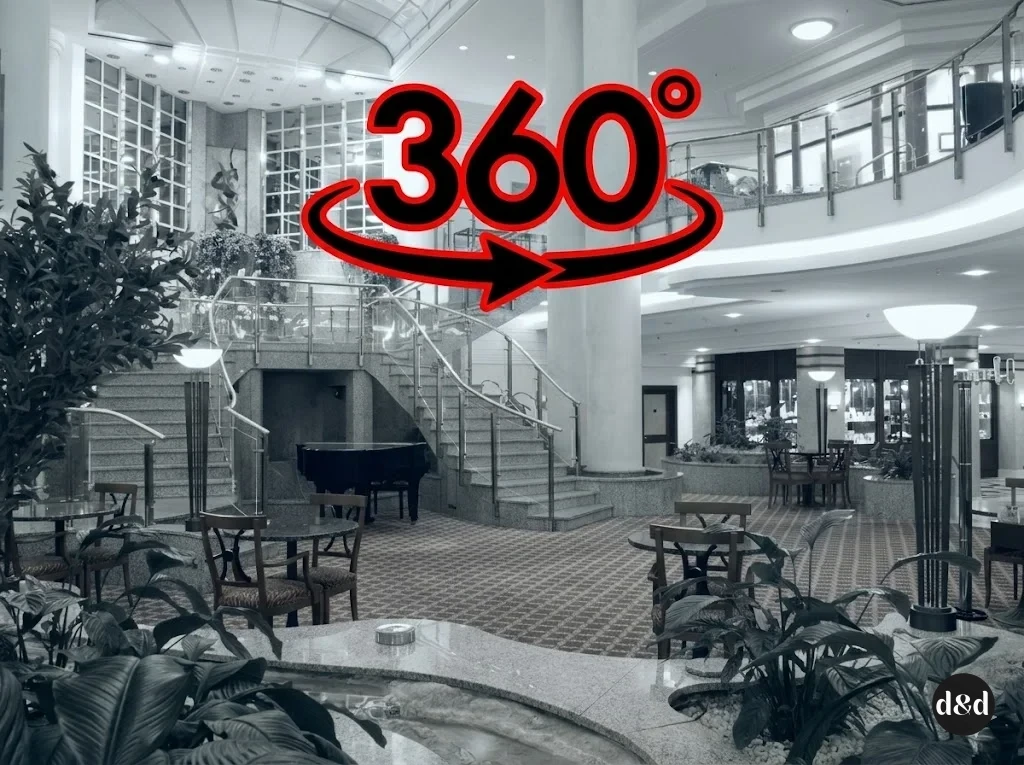
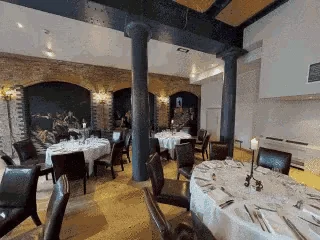 Interactive virtual tours let guests explore venues as if they were there. Source: Actsugi
This transparency builds trust. When guests know exactly what they’re booking, there’s less room for disappointment on arrival. Fewer complaints. Better reviews. Higher return rates.
The Direct Booking Equation
Here’s the business case in brutal terms. I call it the OTA Commission Trap:
- OTA commissions: 15-25% per booking
- If Booking.com takes 20% of a $400/night booking, that’s $80 gone
- On a 100-room hotel at 70% occupancy, that’s potentially $2 million+ annually in commission fees
3D virtual tours on your own website encourage direct booking. Guests who’ve already explored the property immersively have less need for the “reassurance” that third-party platforms provide through reviews and standardised photography. They’ve seen it themselves. They’re ready to book.
The Direct Booking Test: If a guest can get the same immersive experience on your website as they can on an OTA, why would they book through the OTA?
The Event Planner Problem
For hotels with MICE facilities (Meetings, Incentives, Conferences, and Exhibitions), virtual tours solve a specific pain point. I call it the Site Visit Paradox:
Traditional approach:
- Event planner requests site visit
- Someone travels (cost: time + flights + accommodation)
- Your team sets up the space
- 30-minute tour happens
- Planner returns home, tries to remember details
- Decision delayed weeks while other stakeholders request their own visits
Virtual tour approach:
- Event planner accesses 3D tour at 10pm while finalising shortlist
- Shares tour link with colleagues who need to approve
- Everyone explores independently, measures dimensions with built-in tools
- Decision made in days, not weeks
Providers like Actsugi in Malaysia and Singapore have built their entire business model around this. Their 360° tours for hotels feature custom hotspots displaying event configurations, embedded floor plans, and even offline versions for trade shows.
The DIMS Stack: What the Technology Delivers
The dominant platform is Matterport, though alternatives like Kuula and various regional providers offer similar capabilities. Here’s my DIMS framework for evaluating virtual tour features:
D - Dollhouse View: A 3D model of the entire property viewed from above, letting users understand spatial relationships between areas.
I - Interactive Hotspots: Mattertags that display information, link to booking pages, or show additional media like menus or brochures.
M - Measurement Tools: Guests can measure walls, spaces, and furniture placements. Essential for event planning or accessibility considerations.
S - Switching Views: Floor plans, day-to-night timelapse, VR compatibility, aerial photography integration.
For hospitality specifically, day-to-night timelapse features show spaces at different times. Embedded booking links let guests move directly from exploration to reservation.
The Interstate Buyer Phenomenon
Little Hinges, an Australian virtual tour provider, reported that during Queensland’s COVID-era migration wave, 20% of rental inquiries came from interstate. These were people who couldn’t attend physical inspections but needed to make housing decisions.
The same dynamic applies to hospitality:
- International guests researching Australian hotels can’t fly in for a preview
- Business travellers booking venues for their team don’t have time for multiple site visits
- Families planning destination weddings are comparing properties across states
Virtual tours let all of these audiences inspect with confidence. Properties without them simply don’t make the shortlist.
Under the hood: Actsugi's setup
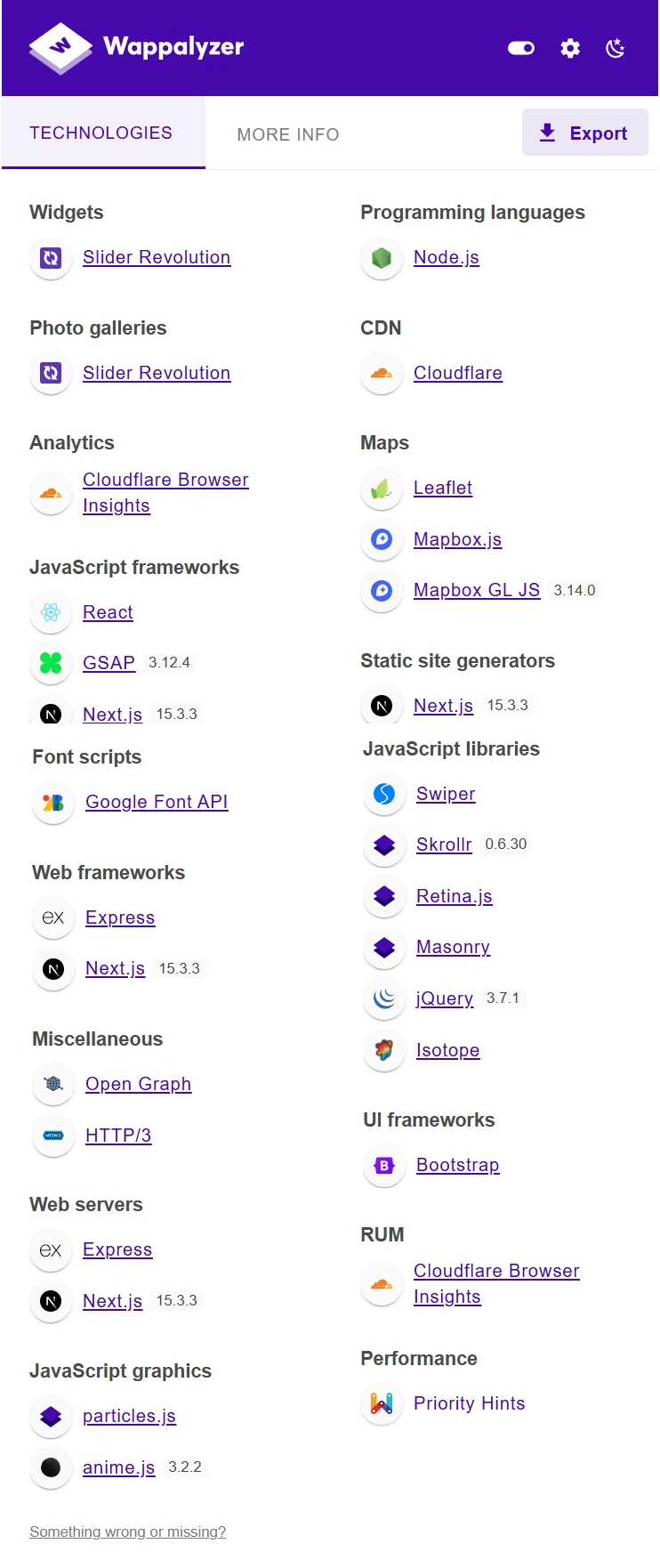 Tech stack captured via Wappalyzer on landing page only.
Actsugi runs their marketing site on Next.js with Cloudflare CDN: modern, fast-loading, appropriate for a visual-heavy portfolio. They use DSLR photography rather than scanning technology, ensuring high colour accuracy and detail even in low-light conditions. The tours themselves are hosted through various 360° platforms and embedded across client properties.
Hotels with 3D virtual tours see 14% more direct bookings and 300% more online engagement. But the real shift isn't the technology: it's what happens when a guest can walk through your property before they book. The booking becomes a confirmation, not a leap of faith. That changes the entire conversion psychology.
Key Takeaways
The competitive advantage is still available. Most properties haven’t adopted virtual tours yet, which means early movers still capture differentiation benefits.
But that window is closing. As more venues add immersive experiences, the absence of a virtual tour becomes conspicuous. Not a neutral gap, but an active disadvantage.
Key takeaways for hospitality operators:
-
The 14-300 Rule:
Virtual tours deliver 14% more bookings and 300% more engagement. This isn't marginal; it's transformational.
-
The OTA Commission Trap:
Every direct booking you capture saves 15-25% in commission. Virtual tours on your website encourage direct booking.
-
The SHOW Framework:
Travellers want Space Reality, Hidden Details, Outside Views, and Walkability. Photo galleries can't deliver this.
-
The Direct Booking Test:
If your website offers the same immersive experience as OTAs, you win. If not, they do.
The implementation isn’t complicated. Professional providers handle the capture, processing, and hosting. Costs range from a few hundred dollars for basic tours to several thousand for full-service production. For a hotel spending tens of thousands on marketing annually, it’s a rounding error.
The question isn’t whether your venue should have a 3D tour. The question is whether you can afford to be invisible while your competitors are walkable.
The AI version of the virtual tour
A 3D tour gives the guest the full picture before they book. AI works on the same principle, but for your hotel's operations. Give the model the full picture of the property, the rooms, the offer, the guest journey, and every downstream task gets faster and sharper.
Generative AI can write room descriptions, draft OTA responses, produce campaign content, answer guest queries, and write housekeeping scripts. It already has the language. What it doesn't have is your property.
That's what we do at jopy.agency. We audit how your hotel actually runs and produce structured files: Brand-Positioning.md, Customer-Journey.md, Service-Blueprint.md, Content-Framework.md (to name a few).
What are Structured .md files?
Markdown (.md) is the cleanest and smallest file format that AI likes to read.
We audit businesses end to end, your operations, workflows, brand, customers, tech, etc., then write all of it into structured .md files.
Then you can use these structured .md files so ChatGPT, Claude, Gemini, or any chat-based LLM can read your business context properly for future, in-house vertical growth.
You can then use AI in-house for your tech stack, bookings, guest comms, marketing content, OTA work, or whatever you want really.
Interested in AI Context Auditing? Visit Jopy.agencyInterested in AI Context Auditing?Cite This Article
APA 7THReferences
Formatted in APA 7th Edition
- iTourVista 3D. (2024). Explore the Benefits of Hotel Virtual Tours. itourvista3d.com
- Actsugi. (2025). Hotel, Resort & Hospitality 360° Virtual Tour Services. actsugi.com
- Matterport. (2025). Create 3D Virtual Tours for Travel & Hospitality. matterport.com
- VirtualTour360. (2025). 3D Virtual Tours for Hotels, Resorts, Spas, Restaurants & Hospitality Venues. virtualtour360.com.au
- Scene3D. (2025). How Hotels Use Virtual Tours to Boost Direct Bookings. scene3d.co.uk