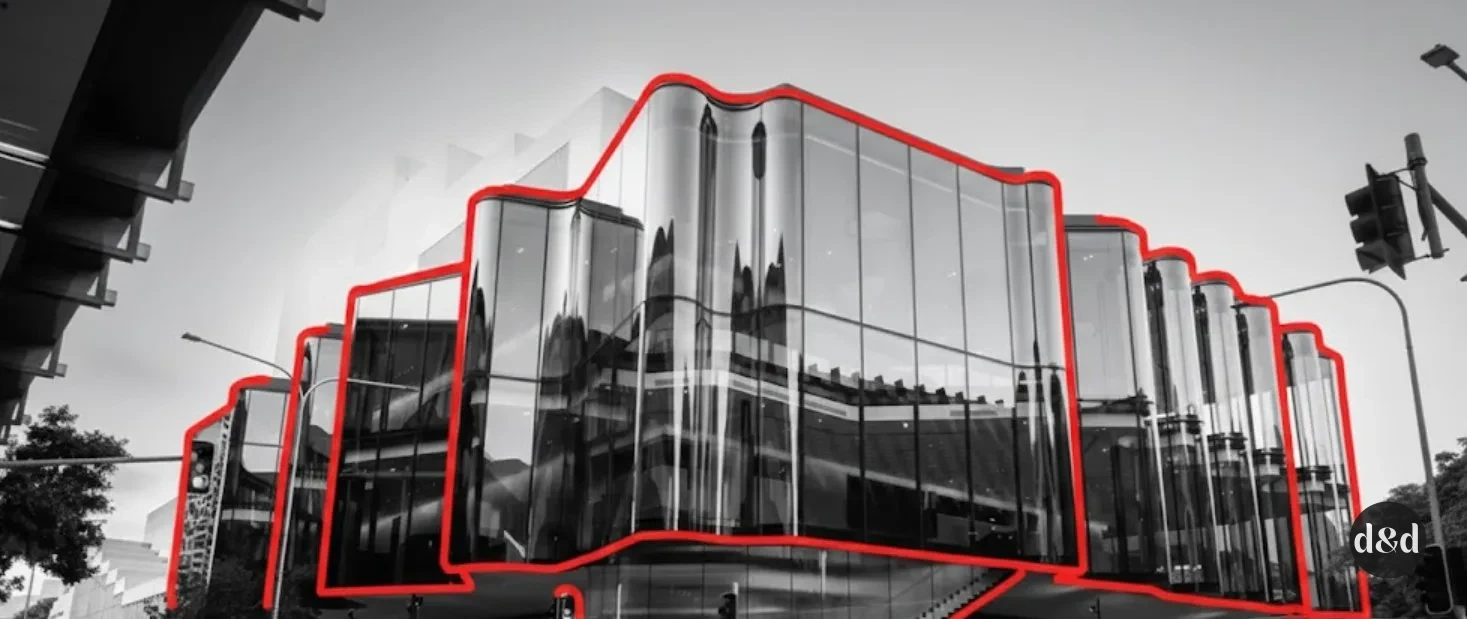
When 5,000 Queenslanders voted to name their state’s newest theatre, 42.7% chose “Glasshouse.” Not because it was clever. Because it was true.
The $184 million theatre that opens on 7 March 2026 is wrapped in 217 panels of curved glass so striking that architects from Oslo to Brisbane have spent seven years figuring out how to make it stand. The result makes QPAC the largest performing arts centre under one roof in Australia.
And it raises a question that matters well beyond Brisbane: can a building designed by Norwegians in collaboration with locals actually feel like it belongs?
The Design Brief Nobody Wanted
When the Queensland Government announced the competition in 2019, they handed architects an impossible constraint. Build a 1,500-seat theatre on a patch of grass barely larger than a tennis court. Do it next to Robin Gibson’s heritage-listed Queensland Cultural Centre, one of the most protected modernist buildings in Australia. Make it world-class. Make it Queenslander.
Twenty-four teams entered. The winners were Blight Rayner, a Brisbane practice founded in 2016 by Jayson Blight and Michael Rayner, partnered with Snøhetta, the Norwegian firm behind the Oslo Opera House.
“We partnered with Snøhetta because of their brilliant cultural building in Oslo,” Michael Rayner said at the announcement. “Their work on the Arts Centre Melbourne involving the modernist heritage architecture of Roy Grounds showed they understood the challenge.”
What Snøhetta Brought to Brisbane
Snøhetta’s Oslo Opera House, completed in 2008, changed how architects think about cultural buildings. Instead of monumental stairs that separate the public from the performance, they created a sloping marble roof that anyone can climb. The opera house became a public park, not a temple.
The philosophy Snøhetta founder Kjetil Thorsen described in 2018 still drives their work: “We wanted to rejuvenate this typology to let the opera and ballet arts also become part of a possible future. This notion led us to create a building closer to a public not specifically familiar with opera.”
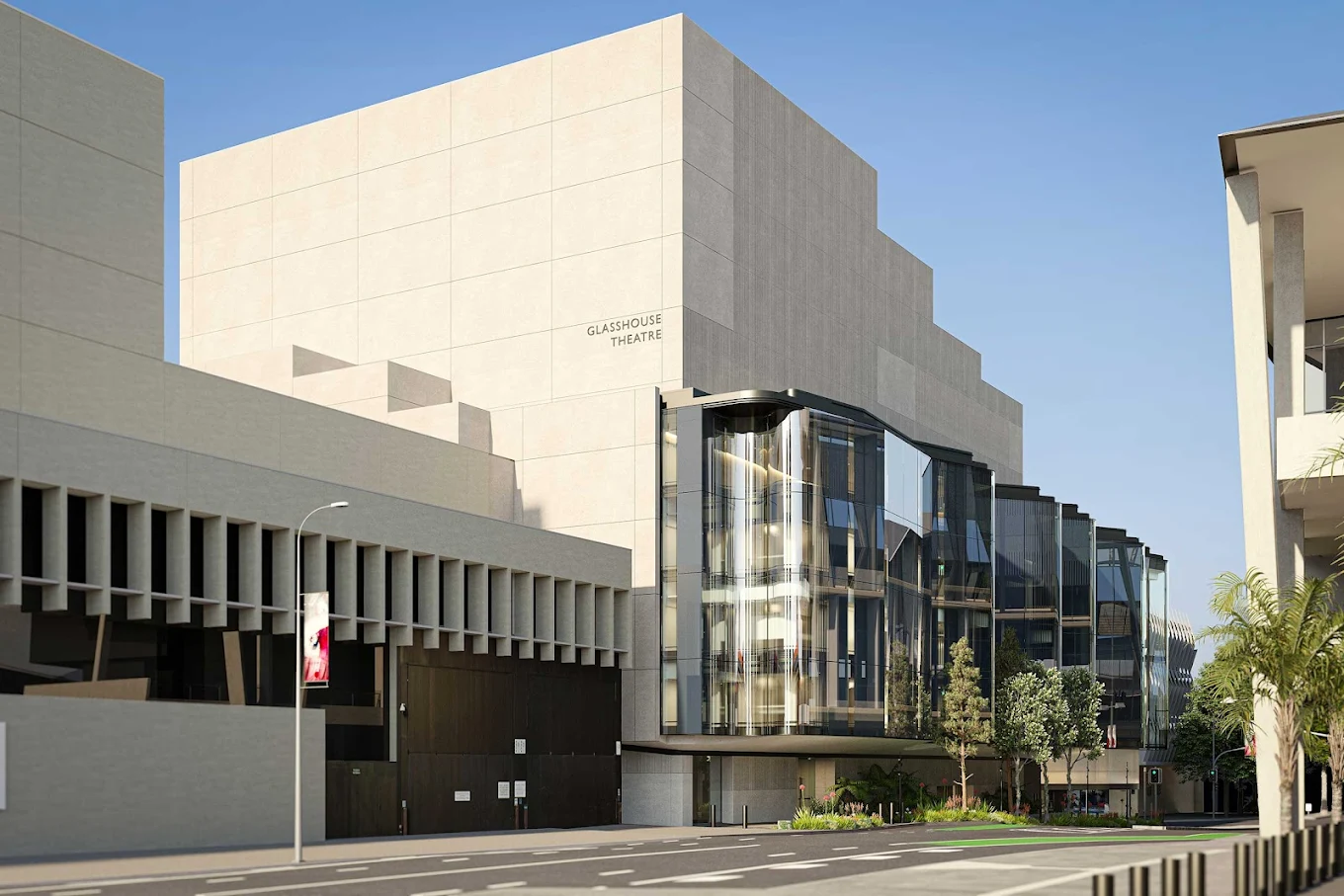
That same thinking shapes the Glasshouse Theatre. Where traditional theatres hide their workings behind grand facades, the Glasshouse wraps its concrete core in transparent glass. The foyers glow at night. Passers-by can see in. The building invites rather than intimidates.
The Local Understanding
But a Norwegian sensibility alone would not work on the Brisbane River. This is where Blight Rayner’s decades of working on South Bank became essential.
Michael Rayner’s CV reads like a history of Brisbane’s riverfront transformation. The Brisbane Convention and Exhibition Centre. The Kurilpa Pedestrian Bridge. The CityCat ferry terminals that survived the 2011 floods by redesigning how structures meet water. In 2025, he received the Lord Mayor’s Lifetime Achievement Award for his contribution to Brisbane’s built environment.
“The location and aesthetic offer incredibly cinematic and diverse landscapes and scenery,” said Jeffrey Greenstein of A Higher Standard, one of many production companies choosing Queensland over traditional filming locations.
The Glasshouse design draws directly on this river knowledge. The curved glass panels ripple like the Brisbane River that flows metres away. Inside, the materials tell Queensland’s story: grey ironbark timber from local forests, green carpet referencing rainforest, gold foyers nodding to beaches. A four-metre bronze sculpture by Torres Strait Islander artist Brian Robinson anchors the entrance plaza.
Respecting Robin Gibson
The Queensland Cultural Centre, designed by Robin Gibson from 1976 to 1988, received heritage listing in 2015 after the Australian Institute of Architects called it “one of the finest buildings in Australia.” Building next to Gibson’s work required navigating a Conservation Management Plan that protects sightlines, materials, and the relationship between buildings.
Gibson, who died in 2014, designed the original QPAC building to capture “the drama and excitement of attending the theatre.” His glass walls rise and fall to mirror internal staircases, creating what architecture writer Deborah Van der Plaat called “circulation spaces that encourage patrons to participate in the performance of visiting the theatre.”
The Glasshouse Theatre continues this idea. The sweeping staircase inside echoes Gibson’s spatial drama. But where Gibson’s 1980s concrete creates weight and permanence, the Glasshouse’s transparency suggests something more provisional, more welcoming, more of this moment.
The Technical Achievement
Beyond aesthetics, the Glasshouse Theatre solves problems that have frustrated performing arts venues for decades.
The 24-metre fly tower stands more than 2.5 times higher than the stage opening, allowing massive sets to disappear upward without audiences seeing the mechanics. QPAC’s first digital fly system replaces manual ropes and counterweighted pulleys with push-button precision. A three-lift orchestra pit accommodates up to 60 musicians with three adjustable floor sections.
Most significantly for Brisbane audiences: the single-balcony design means no bad seats. “From here there is an uninterrupted view of the stage, which seems close enough to touch,” wrote a reporter who visited the back row of the balcony during a preview tour.
And yes, they doubled the number of bathrooms.
The Numbers That Matter
The Glasshouse Theatre cost $184 million: $159 million from the Queensland Government and $25 million from QPAC. Construction ran from 2020 to late 2025, several years behind the original 2022 target.
The investment is calculated to return through attendance. QPAC currently welcomes 1.3 million visitors annually. The Glasshouse adds capacity for 300,000 more, bringing potential visitation to 1.6 million. The new theatre can host an additional 260 performances per year.
Opening season bookings suggest the calculation is working. Queensland Ballet’s Messa da Requiem runs 27 March to 4 April. Sting’s The Last Ship, the Australian exclusive, plays 9 April to 3 May. Leah Purcell’s The Drover’s Wife world premiere follows 13 to 22 May.
QPAC didn't become Australia's largest performing arts centre by competing with Sydney's established institutions on prestige. It built infrastructure designed for a different kind of city: one where outdoor spaces, community programming, and subtropical architecture are the competitive advantages, not marble foyers and chandelier lobbies.
What This Means for Brisbane 2032
The Glasshouse Theatre arrives six years before Brisbane hosts the 2032 Olympic and Paralympic Games. That timing is not coincidental.
“This 1,500-seat theatre gives us greater capacity to attract world-class talent and Australian exclusives to Queensland,” said QPAC Chief Executive Rachel Healy. “It forges our reputation as one of Australia’s biggest and busiest cultural precincts as we move towards the Brisbane 2032 Olympic and Paralympic Games.”
Michael Rayner’s practice has already led reference designs for two major 2032 Olympic venues and peer reviews for both the main stadium and Brisbane Arena. The Glasshouse Theatre sits within a transformation that will reshape South Bank through the decade.
For Queensland’s Time to Shine, the state’s 10-year arts and cultural strategy, the theatre provides the anchor venue for building cultural tourism ahead of global attention.
The Broader Design Question
Cultural buildings carry weight beyond their programming. They signal what a city values. The Sydney Opera House, the Melbourne Arts Centre spire, GOMA’s angular boxes: these shapes become shorthand for the cities they represent.
The Glasshouse Theatre makes a different statement. Rather than a singular landmark meant to photograph well from a distance, it creates a building that dissolves into its context. The glass reveals rather than conceals. The materials reference the landscape rather than importing prestige. The heritage relationship acknowledges rather than overshadows.
Whether this represents a maturation of Brisbane’s architectural confidence or a missed opportunity for boldness depends on what you want from cultural buildings. The question the Glasshouse answers is simpler: can a theatre feel like it belongs to everyone who sees it?
On 7 March, when Queenslanders walk through those glass doors for the first time, they will have their answer.
Community Day Details
When: Saturday 7 March 2026, 9am to 4.30pm
What: Free entry to explore the theatre. Limited guided tours available (bookings opened 6 February). Pop-up performances throughout the day. Both bars open.
Where: QPAC Glasshouse Theatre, corner Grey and Russell Streets, South Bank, Brisbane
More information: qpac.com.au
What AI looks like at scale for arts and cultural venues
The Glasshouse Theatre works because QPAC designed it for Brisbane, not for somewhere else. The identity is specific to the place. AI is only useful for a venue on the same basis: it needs to understand your season, your audience, your funders, and your identity, not a generic idea of "arts".
Generative AI can draft season announcements, write audience comms, respond to ticketing queries, and produce education content. It already has the craft. What it doesn't have is your programming.
That's what we do at jopy.agency. We audit how your venue actually operates and produce structured files: Brand-Positioning.md, Customer-Journey.md, Content-Framework.md, Service-Blueprint.md (to name a few).
What are Structured .md files?
Markdown (.md) is the cleanest and smallest file format that AI likes to read.
We audit businesses end to end, your operations, workflows, brand, customers, tech, etc., then write all of it into structured .md files.
Then you can use these structured .md files so ChatGPT, Claude, Gemini, or any chat-based LLM can read your business context properly for future, in-house vertical growth.
You can then use AI in-house for content creation like season comms, education programs, audience development, donor comms, or scaling your technical stack, etc.
Interested in AI Context Auditing? Visit Jopy.agencyInterested in AI Context Auditing?Cite This Article
APA 7THReferences
Formatted in APA 7th Edition
- Queensland Performing Arts Centre. (2026, February). QPAC's Much-Awaited Glasshouse Theatre to Open Its Doors. QPAC Newsroom. https://www.qpac.com.au/newsroom/2026/qpacs-much-awaited-glasshouse-theatre-to-open-its-doors
- Arts Queensland. (2025). Glasshouse Theatre. Queensland Government. https://www.arts.qld.gov.au/projects-and-partnerships/glasshouse-theatre
- Blight Rayner Architecture. (2025). New Performing Arts Venue. https://blightrayner.com.au/portfolio_page/glasshouse-theatre/
- Snøhetta. (2019). The Glasshouse Theatre. https://www.snohetta.com/projects/queensland-performing-arts-centre
- Department of Environment and Heritage Protection. (2015). Queensland Cultural Centre heritage listing. Queensland Heritage Register. https://apps.des.qld.gov.au/heritage-register/detail/?id=602844
- Queensland Government. (2026, February). New Glasshouse Theatre sets the stage for ultimate audience experience. Ministerial Media Statements. https://statements.qld.gov.au/statements/104411
- Blight Rayner Architecture. (2025). Michael Rayner Honoured for Shaping Brisbane's Skyline. https://blightrayner.com.au/michael-rayner-honoured/
- ArchDaily. (2019). Snøhetta and Blight Rayner Design New Theater to Create Australia's Largest Performing Arts Center. https://www.archdaily.com/917738/snohetta-and-blight-rayner-design-new-theater
- Designboom. (2018). Snøhetta's Kjetil Thorsen discusses the design of the Oslo Opera House. https://www.designboom.com/architecture/snohetta-kjetil-thorsen-interview/