
Officeworks. Kogan. Petstock. Weber. NBN. Bondi Sands.
These aren’t clients of McKinsey’s digital practice or Deloitte Digital. They’re working with a 100-person agency founded by a teenager who was homeless at the time.
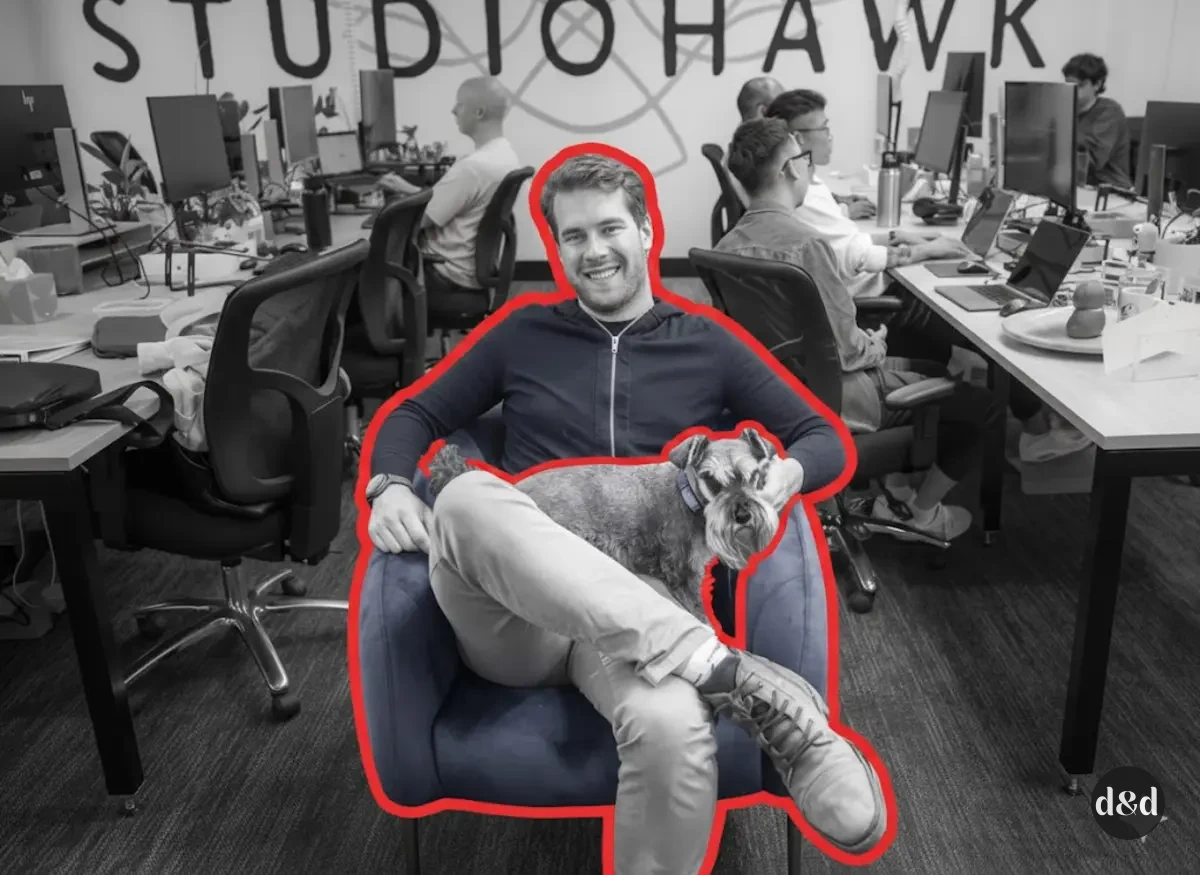
StudioHawk, headquartered in Prahran, has quietly become Australia’s largest specialist SEO agency. And the way they’ve done it reveals something important about how enterprise clients actually choose their partners in 2026.
The Big Agency Problem Nobody Talks About
Here’s what happens when a major Australian retailer hires a Big Four consultancy for SEO:
They get a partner who pitches the work. They get an account manager who handles communications. They get a team of juniors who actually do the work. The partner moves on to the next pitch. The account manager becomes a bottleneck. The juniors rotate off the project every few months.
The client ends up explaining their business, their goals, and their technical constraints over and over again. They’re paying premium rates for a communication layer that adds friction rather than value.
I’ve seen this pattern across every industry I work in. The bigger the agency, the more distance between the people who understand your business and the people actually doing the work.
StudioHawk’s model is the opposite. No account managers. You work directly with SEO specialists. The person who audits your site is the person who implements fixes and the person on your calls.
It sounds simple. But for enterprise clients managing complex technical environments, it changes everything.
How a 17-Year-Old Rebuilt the Agency Model
Harry Sanders learned SEO at 13, trying to save his father’s boat licensing business from a disastrous agency contract. By 17, he’d started StudioHawk. He was also homeless, living under a bridge in Melbourne and using the WiFi at Vinnies to work on client projects.
That origin story matters because it explains the company’s DNA. Sanders didn’t build an agency based on what agencies are supposed to look like. He built one based on what clients actually need.
No lock-in contracts. If you’re not seeing results, you leave. The agency has to earn your business every month.
Specialists only. No generalists trying to be everything to everyone. Every person at StudioHawk does SEO. That’s it.
Direct access. The specialists who do the work are the ones on client calls. No translation layers. No game of telephone between your marketing team and the people implementing changes.
The result: 300% average ROI across their client base, and over 250 Google reviews with a 4.9-star rating. More importantly, zero clients have been penalised by Google due to their work, across more than 1,000 campaigns.
The Technical Value Creation Model
Where StudioHawk really differentiates is in how they create value through technical execution. This is the part that matters for anyone evaluating agencies.
Developer Integration
For enterprise clients, SEO isn’t just about content and keywords. It’s about technical implementation across complex platforms. StudioHawk embeds directly with development teams. When Officeworks migrated their site to a new React build, the SEO team worked alongside developers to resolve crawlability issues in real-time.
The specific problem: React pages weren’t rendering properly for search engines. Internal linking structures had orphaned important pages. Legacy systems were slowing tracking implementation.
A traditional agency would have produced an audit document and handed it to the client’s dev team. StudioHawk’s team worked in the codebase, identifying issues as they emerged during the migration and implementing fixes before Google could lock in negative patterns.
Result: 60% increase in organic traffic. 32% increase in organic revenue. Thousands of crawl errors eliminated.
Stakeholder Communication Architecture
Enterprise SEO involves multiple stakeholders: marketing teams, developers, product managers, executives. Most agencies default to monthly reports and quarterly reviews.
StudioHawk uses a fortnightly cadence with direct specialist access. But more importantly, they create what they call “SEO playbooks,” documentation that enables internal teams to replicate and scale improvements independently.
For Officeworks, this meant content templates for thousands of product pages, keyword mapping frameworks that product teams could apply without waiting for agency input, and technical standards that development could implement during their normal sprint cycles.
The agency isn’t just doing work. They’re building capability within the client organisation.
Migration Expertise
Site migrations are where most agency relationships fail. The stakes are high, the technical complexity is real, and traditional agencies aren’t structured to respond quickly.
StudioHawk has completed over 150 migrations. They’ve built specific processes for the chaos: rapid deployment of fixes, direct developer communication channels, real-time monitoring during launch windows.
When things go wrong (and they always do during migrations), the response time is hours, not weeks. The people on the call are the people who can actually fix the problem.
The AI Search Pivot
The most interesting strategic move StudioHawk has made is their early investment in AI search optimisation. They’re not just optimising for Google anymore. They’re optimising for how brands appear in ChatGPT, Perplexity, and Google’s AI Overviews.
This is where specialisation pays off. A full-service agency is still figuring out what AI search means for their various practice areas. StudioHawk has already built frameworks, trained their team, and published white papers on the methodology.
Their approach: entity optimisation, structured data implementation, and content architecture designed for how large language models understand and cite sources.
For enterprise clients, this forward positioning matters. The agencies that figure out AI search early will capture the next wave of organic visibility. The generalists will be playing catch-up.
The Business Model Trade-offs
StudioHawk’s model isn’t perfect. There are legitimate reasons why some clients choose Big Four consultancies.
Scale limitations. With 100 specialists across Melbourne, Sydney, London, and Atlanta, they can’t staff 50-person engagements. If you need a massive team deployed quickly, traditional consultancies have more bodies.
Adjacent services. StudioHawk does SEO. If you need SEO plus paid media plus creative plus brand strategy plus CRM implementation, you’ll need multiple vendors. The Big Four can bundle everything.
Executive access. Some organisations need the credibility of a McKinsey or Deloitte name in board presentations. StudioHawk has Forbes 30 Under 30 recognition and industry awards, but they’re not a household name with executives who don’t work in marketing.
But for clients whose primary need is technical SEO execution at enterprise scale, the specialist model creates better outcomes. The numbers bear this out.
What This Means for Melbourne's B2B Services Market
StudioHawk’s success reflects a broader trend in professional services. Clients are increasingly willing to work with specialists rather than full-service firms.
The pattern holds across industries. Boutique strategy consultancies are winning work from MBB. Specialist legal firms are taking market share from full-service practices. Niche technology consultancies are competing with Accenture and IBM.
The common thread: clients are realising that the generalist premium doesn’t always translate to better outcomes. A firm that does one thing exceptionally well often delivers more value than a firm that does everything adequately.
For Melbourne’s professional services ecosystem, this creates opportunities. The city has the talent base, the enterprise client density, and the cost structure to support specialist consultancies across multiple domains.
StudioHawk proved the model works for SEO. The question is: what’s the next vertical?
StudioHawk proved that in a market dominated by global consulting firms, a specialist boutique can win enterprise clients by doing one thing exceptionally well rather than everything adequately. Australia's biggest brands didn't choose StudioHawk despite its size. They chose it because of it.
Key Takeaways
-
Structure, not size, drives ROI:
StudioHawk's 300% average return comes from eliminating the account-manager layer, not from some secret SEO technique. Specialists do the work and sit on client calls.
-
Specialists beat generalists on enterprise work:
For complex technical environments, a focused boutique can win against the Big Four because they work directly in the codebase instead of producing audit documents.
-
The specialist model demands client maturity:
Your internal team has to coordinate multiple vendors and let external specialists talk directly to developers. Not every organisation is ready for that.
-
No lock-in contracts force quality:
Month-to-month means the agency has to earn the business every month. That discipline shows up in 4.9-star reviews and zero Google penalties across 1,000+ campaigns.
-
Prestige vs performance is a real trade-off:
The biggest clients in Australia chose StudioHawk over McKinsey and Deloitte. If the CMO can't defend that choice to the board, the specialist model doesn't win.
Sometimes the most innovative thing a company can do is strip away everything that doesn’t create value. StudioHawk figured that out while their founder was living under a bridge. Ten years later, they’re winning business from the biggest consultancies in the world.
Why specialist agencies have the biggest AI upside
StudioHawk's edge is specialists doing the work, with no translation layer between the brief and the output. That makes their knowledge their product. Capture it, and AI starts multiplying it. Leave it in people's heads, and it walks out the door when they leave.
Generative AI can already brief juniors, draft proposals, QA deliverables, and write client updates at the level of a competent mid-level. The only reason AI output feels generic is it doesn't know your methodology, your playbooks, or your past work.
That's what we do at jopy.agency. We audit how your agency actually delivers and produce structured files: Service-Blueprint.md, Brand-Positioning.md, Operations-Model.md, Content-Framework.md (to name a few). AI then works on your IP, not on someone else's idea of your trade.
What are Structured .md files?
Markdown (.md) is the cleanest and smallest file format that AI likes to read.
We audit businesses end to end, your operations, workflows, brand, customers, tech, etc., then write all of it into structured .md files.
Then you can use these structured .md files so ChatGPT, Claude, Gemini, or any chat-based LLM can read your business context properly for future, in-house vertical growth.
You can then use AI in-house for briefing, proposals, QA, pitch prep, reporting, or whatever you want really.
Interested in AI Context Auditing? Visit Jopy.agencyInterested in AI Context Auditing?Cite This Article
APA 7THReferences
Formatted in APA 7th Edition
- SmartCompany. (2019). From homeless to $1.3 million in billables: The story of 21-year-old entrepreneur Harry Sanders. SmartCompany
- Forbes. (2020). 30 Under 30 Asia: Marketing & Advertising. Forbes Media.
- StudioHawk. (2026). Officeworks Case Study. StudioHawk
- The Finance Story. (2025). Ex-McKinsey consultant confirms in the AI Era, Boutiques are Winning. The Finance Story