The Anti-Sandstone University
I have spent considerable time observing how educational institutions present themselves digitally. Most Australian universities look the same: Gothic architecture, Latin mottos, and marketing that speaks to prestige rather than outcomes. Then there is Torrens University, which does everything differently.
Founded in 2014, Torrens was Australia’s first new university in 20 years. In 2020, Strategic Education Inc. acquired it for $642.7 million. That is a remarkable valuation for an institution that started with just 164 students a decade earlier.
The story of how they got there is fundamentally a design story.
Industry-First as Design Philosophy
Torrens operates on a simple premise that most universities ignore: students attend university to get jobs. This sounds obvious, but the implications for how you design an educational brand are profound.
Traditional universities lead with research output, faculty credentials, and heritage. Torrens leads with employability metrics. Their homepage prominently displays rankings from QILT (Quality Indicators for Learning and Teaching), the government’s official student experience survey. Not tucked away in an “About” section, but front and centre.
The numbers are striking. #1 in Australia for Skills Development with 87% satisfaction. Top 3 for Educational Experience. #1 MBA of choice in Australia by student enrollment. CEO Dan Cockerell frames this positioning clearly: achieving top national ranking for postgraduate skills development reflects the university’s commitment to employability-focused education.
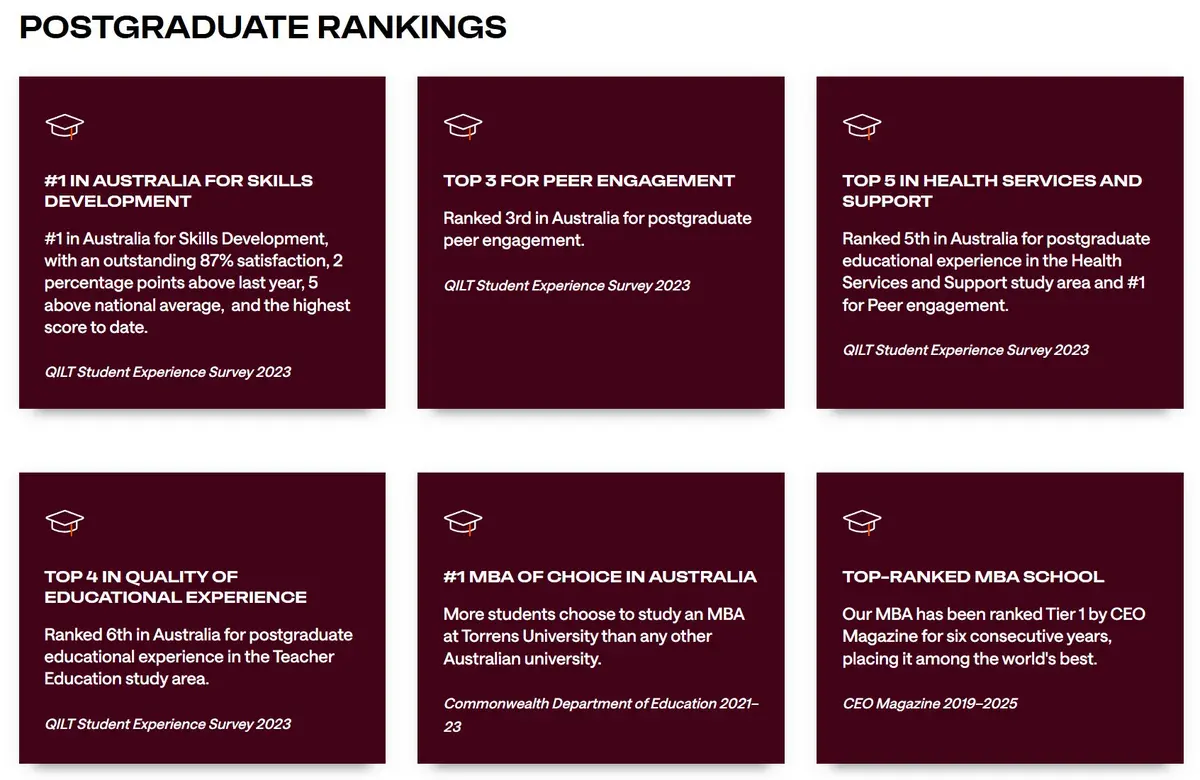 Torrens prominently displays QILT rankings, positioning employability as their core value proposition
This is not just marketing. The curriculum is co-designed with industry partners including IBM, AWS, SAP, Vogue Australia, Sony PlayStation, and Real Madrid Graduate School. Students complete 120+ hours of work-integrated learning on real client briefs. The Blue Mountains International Hotel Management School operates a fully simulated hotel where students live and work.
The design choice to lead with outcomes rather than prestige is strategic. Torrens cannot compete with the University of Sydney’s 170-year heritage or Melbourne’s sandstone prestige. So they do not try. Instead, they compete on what matters to prospective students: will this degree get me a job?
The SomeOne Rebrand: Morphing Shapes and Movement
In 2018, Sydney agency SomeOne undertook a comprehensive rebrand of Torrens University and its subsidiary schools, including Billy Blue College of Design and Blue Mountains International Hotel Management School. The work won GOLD for Best Visual Identity in Education at the Transform Awards.
The visual system they developed uses morphing, fluid shapes that suggest movement and transformation. This is not accidental. Traditional university crests are static, authoritative, historical. Torrens’ identity is dynamic, contemporary, forward-looking.
The colour palette is vibrant: deep burgundy, bright orange, electric blue. Compare this to the muted sandstone and forest green of Australia’s Group of Eight universities. The Torrens brand explicitly targets younger demographics who grew up with digital-first experiences.
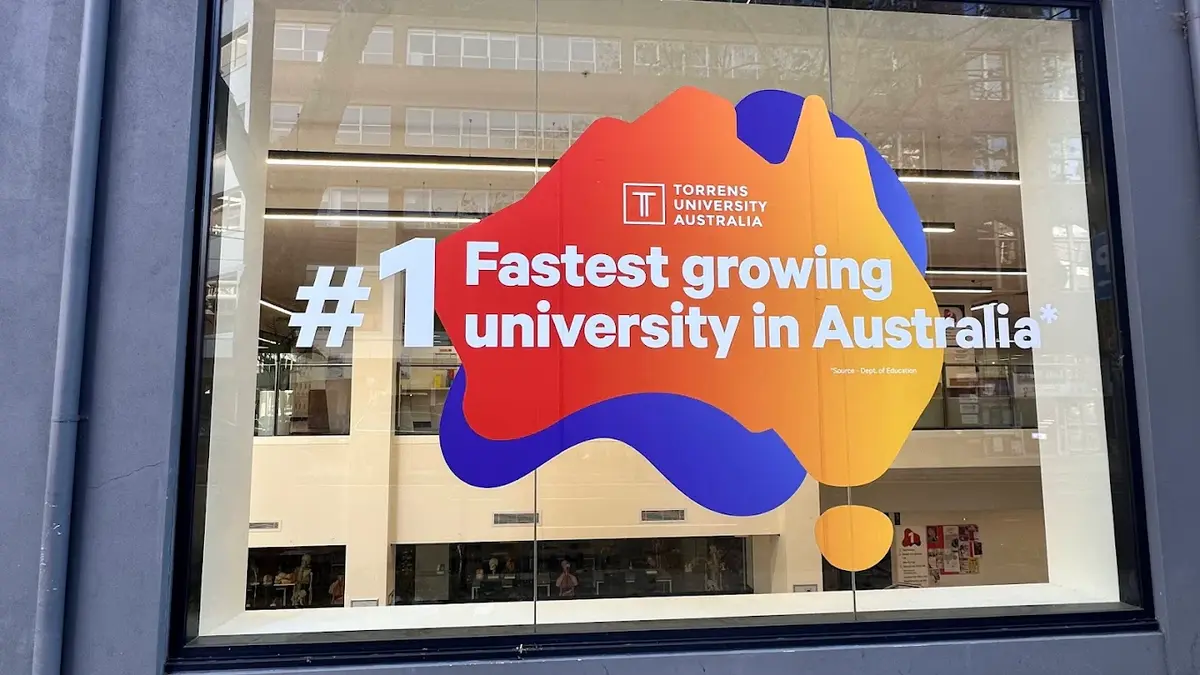 The morphing brand shapes communicate transformation and movement, a deliberate contrast to static university crests
The Billy Blue sub-brand goes further. SomeOne reimagined the college’s namesake character (a historical figure, not a mascot) to be more approachable and contemporary. The visual system uses hyper-real 3D renderings that feel tangible, almost like digital modelling clay you could reshape yourself.
For Blue Mountains Hotel School, the approach was refined: white-on-white morphing shapes that evoke crisp hotel linens and immaculate service. Same design system, calibrated for a different audience.
The Brand Consistency Challenge
No design system is perfect. Torrens has an interesting tension in how their sub-brands integrate with the master brand.
When you navigate to the Design category on torrens.edu.au, the visual language shifts noticeably. The Billy Blue pages use a darker, more creative treatment that differs from the corporate Torrens aesthetic. This creates what UX practitioners would call a “jarring” experience.
*Scrolling through the Torrens website reveals distinct visual treatments between the master brand and Billy Blue College of Design*This is a strategic choice, not an oversight. Billy Blue has brand equity built since 1987 when it was founded by Sydney designer Ross Renwick. The college has its own reputation in the creative industry. Maintaining visual differentiation preserves that equity while still operating under the Torrens umbrella.
Whether this trade-off is worth the UX friction is debatable. From a pure usability standpoint, the transitions could be smoother. From a brand strategy standpoint, the differentiation may be exactly what prospective design students want to see: evidence that this is still a design school, not a corporate university that acquired a design school.
Physical Space as Brand Expression
The Surry Hills campus in Sydney demonstrates how Torrens extends their brand into physical environments. Located at 17 Foveaux Street, the space looks nothing like a traditional lecture hall.
Exposed brick, industrial timber beams, colourful mismatched furniture, a cafe serving coffee. It looks more like a WeWork or a creative agency than a university. The design is intentional. These are the environments students will work in after graduation. Why not start learning in them now?
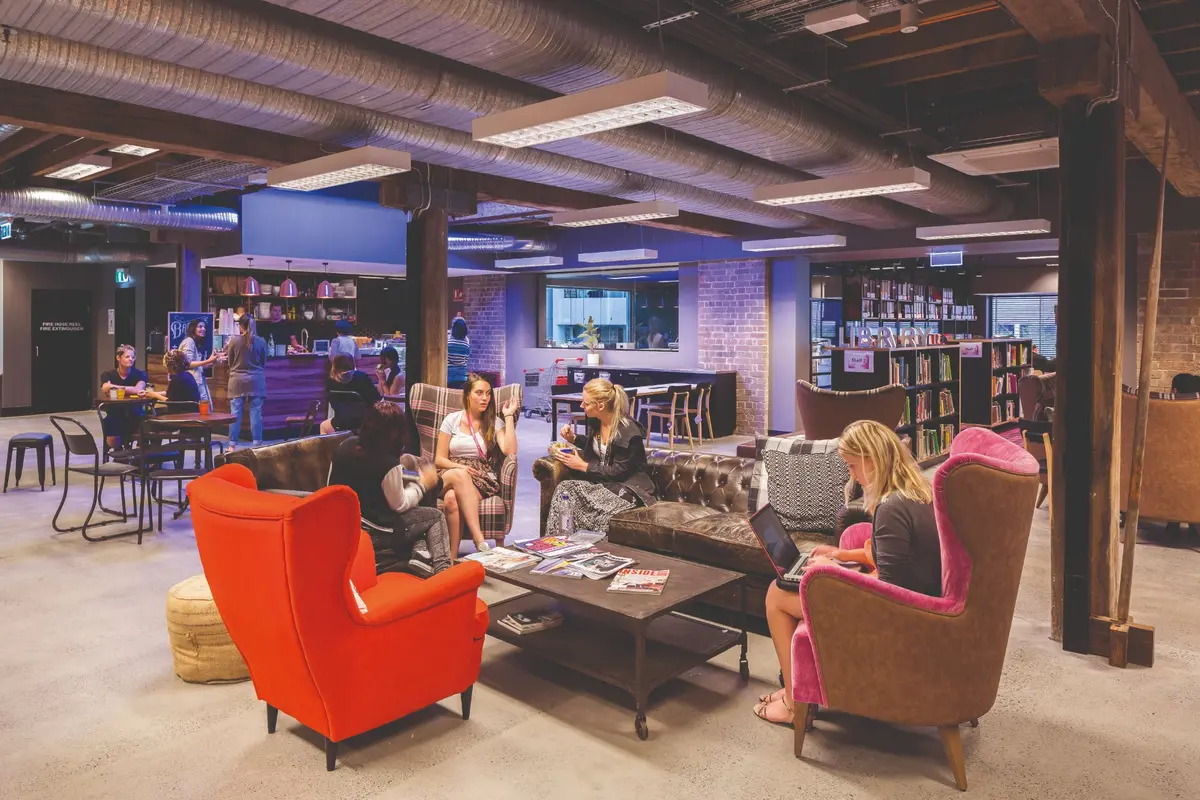 The Surry Hills campus feels more like a creative agency than a traditional university
The campus locations themselves are strategic. Surry Hills is Sydney’s creative and tech hub. Fortitude Valley is Brisbane’s equivalent. Flinders Street puts Melbourne students in the CBD. Adelaide’s Wakefield Street campus occupies the heritage-listed former Menz Biscuits factory.
These are not suburban mega-campuses with sprawling lawns. They are urban, accessible, embedded in the industries they serve.
The Economic Argument
Torrens commissioned Deloitte Access Economics to analyse their economic impact. The 2024 report found $800+ million in economic contribution across Australia, with 2,951 full-time equivalent jobs supported.
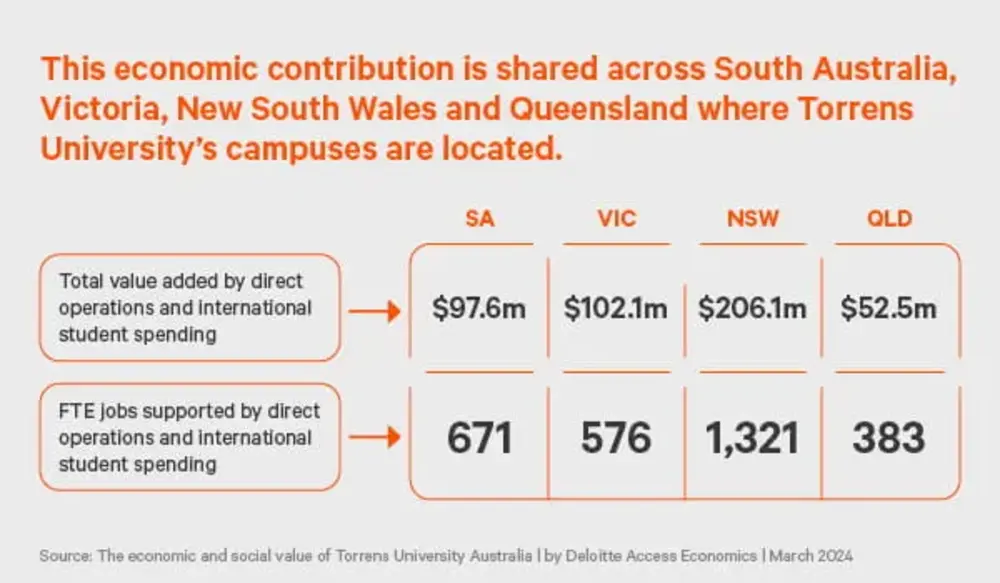 NSW leads with $206.1M in economic contribution, reflecting Sydney’s position as the largest campus
NSW contributes $206.1 million and 1,321 FTE jobs. Victoria follows at $102.1 million. This data serves multiple purposes: it validates the business model to investors, demonstrates value to policymakers, and signals stability to prospective students.
The fact that Torrens publishes this data prominently is itself a brand decision. Traditional universities rarely quantify their economic impact so explicitly. Torrens treats these metrics as proof points, the same way a tech startup would cite revenue growth.
Innovation as Differentiator
The awards section of the Torrens website reads like a tech company’s press page.
ASCILITE Innovation Award 2024 for an extended reality psychology tool. Business Analysis Innovation of the Year 2023 from IIBA. Catalyst Award for their Virtual Design Studio. Three consecutive years on the AFR BOSS Most Innovative Companies list (2019-2022).
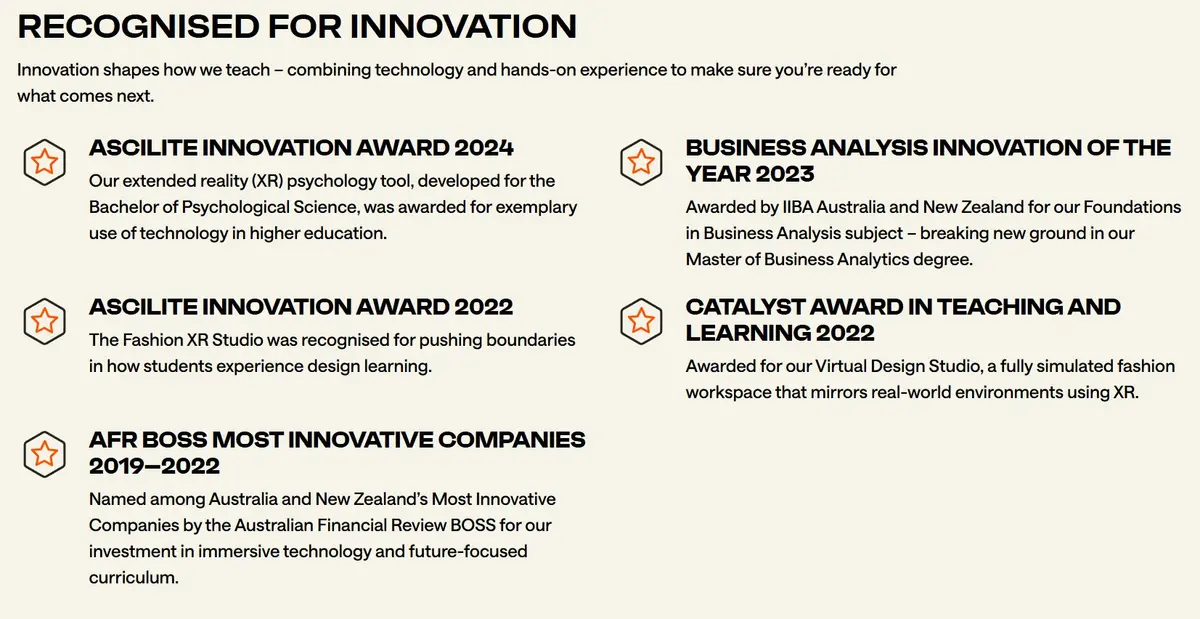 Innovation awards position Torrens as a technology-forward institution
These are not the awards traditional universities chase. They are not research citations or international rankings. They are innovation and industry awards, recognition for doing things differently.
The MBA program exemplifies this. Torrens MBA lecturers were named Most Inspirational MBA Lecturers by MBAus in both 2023 and 2024. CEO Magazine has ranked the program Tier 1 for six consecutive years. More students choose to study an MBA at Torrens than at any other Australian university, according to Commonwealth Department of Education data.
Where Torrens Falls Short
No institution is without weaknesses. In the interest of balanced analysis, here are areas where Torrens could improve.
Research credibility. Torrens is not in the Group of Eight. It does not compete with Melbourne or Sydney on research output. For students seeking academic careers or deep theoretical grounding, this matters. The industry-first model trades research depth for practical application.
Course evolution pace. While 300-level subjects tend to be cutting-edge, some foundational 100-level courses lag behind industry practice. This is a common challenge in rapidly evolving fields like technology and design: by the time curriculum is approved and delivered, some content is already dated. To be fair, this affects most universities, and standardising assessment for diverse student cohorts is genuinely difficult.
Digital marketing gaps. Torrens builds strong TikTok content for youth recruitment, but their Reddit presence and broader generative AI SEO strategy lags competitors. As Google increasingly weights human experience signals and user-generated content, this gap will widen. The traditional SEO approach that worked in 2020 needs updating for the GEO (generative engine optimisation) era.
Administrative consistency. Some student reviews cite issues with enrollment processes and communication. Rapid growth creates operational strain. This is not unique to Torrens, but it does affect the student experience.
The Leadership Transition
Linda Brown, who led Torrens from startup to $642 million acquisition as CEO and President, stepped back from the CEO role at the start of 2025. She remains on the board as a director and continues as an EY Entrepreneur Of The Year judge.
Dan Cockerell now serves as CEO. The leadership transition coincides with Torrens entering its second decade, shifting from startup growth mode to institutional maturity.
 CEO Dan Cockerell at Torrens University’s 10-year anniversary celebration
The strategic direction remains consistent: industry-first education, employability metrics as key performance indicators, B Corp certification as values signal. Whether the brand execution evolves under new leadership remains to be seen.
Torrens University went from 164 students to a $642M exit not by competing with sandstone institutions on their terms, but by building an industry-first positioning strategy where every degree, every campus, and every digital touchpoint was designed around employer needs rather than academic tradition. The design system wasn't cosmetic. It was the business model.
Lessons for Any Business
Torrens’ design strategy offers transferable insights for businesses challenging established incumbents.
Compete on different metrics. Torrens cannot win on heritage or research prestige. So they redefined success as employability and skills development, then built their entire brand around proving they deliver on those metrics. What metric could you own in your industry?
Make your spaces match your promise. If you claim to prepare students for creative industry work, your campus should look like a creative workplace. If you claim to be customer-centric, your offices should reflect that. Physical environment is brand expression.
Let sub-brands breathe. The Billy Blue visual distinction from Torrens corporate shows that acquired brands can retain identity while operating under a parent. The trade-off between consistency and differentiation is worth considering for any multi-brand business.
Quantify your value proposition. The Deloitte economic impact report, the QILT rankings, the enrollment statistics. Torrens backs up positioning with data. What third-party validation could strengthen your claims?
Design for your actual audience. The morphing shapes and vibrant colours explicitly target younger, digitally-native students. Traditional universities design for heritage and authority. Know who you are serving and design accordingly.
The Broader Shift
Torrens’ success reflects a broader shift in how Australians evaluate education. The traditional prestige model, where a sandstone university name alone opens doors, is eroding. Employers increasingly care about skills and practical experience over institutional pedigree.
This does not mean traditional universities are obsolete. Research-intensive careers still require research-intensive training. But for the majority of students seeking industry careers, the Torrens model offers a compelling alternative.
The $642 million valuation suggests investors agree.
Whether Torrens can maintain its position as it scales, whether the B Corp certification remains meaningful, whether the brand consistency challenges get resolved, these questions remain open. But as a case study in how design thinking can differentiate an institution in a century-old industry, Torrens University is worth watching.
The fastest-growing university in Australia did not get there by copying what came before. They redesigned what a university could be.
What design systems can teach about AI context
Torrens grew because their brand, communications, and student experience reinforced a single story. That's a design system in practice. The AI equivalent is a context system: a set of files that means every prompt, every response, every output comes from the same foundation.
Generative AI can draft course descriptions, write enquiry responses, produce recruitment content, and respond to student emails. It already writes well. What it needs is a consistent understanding of your institution.
That's what we do at jopy.agency. We audit how your institution actually runs and produce structured files: Brand-Positioning.md, Customer-Journey.md, Content-Framework.md (to name a few).
What are Structured .md files?
Markdown (.md) is the cleanest and smallest file format that AI likes to read.
We audit businesses end to end, your operations, workflows, brand, customers, tech, etc., then write all of it into structured .md files.
Then you can use these structured .md files so ChatGPT, Claude, Gemini, or any chat-based LLM can read your business context properly for future, in-house vertical growth.
You can then use AI in-house for recruitment, student comms, course content, staff onboarding, or whatever you want really.
Interested in AI Context Auditing? Visit Jopy.agencyInterested in AI Context Auditing?Cite This Article
APA 7THReferences
Formatted in APA 7th Edition
- Torrens University Australia. (2026). Rankings and ratings. Torrens University. https://www.torrens.edu.au/studying-with-us/why-study-with-us/rankings
- Deloitte Access Economics. (2024, March). The economic and social value of Torrens University Australia. Torrens University. https://www.torrens.edu.au/stories/newsroom/university-news/torrens-universitys-800-million-economic-impact
- SomeOne. (2019). It all starts with an idea: Billy Blue and Blue Mountains rebrand. SomeOne in Sydney. https://someoneinsydney.com/projects/8025
- Strategic Education, Inc. (2020, July 29). Strategic Education, Inc. to acquire Laureate Education, Inc.'s Australia and New Zealand academic operations. Business Wire. https://www.businesswire.com/news/home/20200729005293/en/
- Mi3 Australia. (2024, November 13). Q Agency doubles team amid Western Sydney's economic transformation. Mi3. https://www.mi-3.com.au/13-11-2024/q-agency-doubles-team-amid-western-sydneys-economic-transformation
- Torrens University Australia. (2025, November). Ranked #1 nationally for postgraduate skills development. Torrens University. https://www.torrens.edu.au/stories/newsroom/university-news/ranked-1-nationally-for-postgraduate-skills-development-in-2024-student-experience-survey