
1,400 students, 6 awards, and a contact button you’d scroll right past
Uplift Education has been coaching Year 7 to 12 students in Liverpool since 2011. They’ve won four Local Business Awards, produced ATAR scores above 95 consistently (including a 99.95), coached over 1,400 students, and earned the kind of Google reviews that most education businesses would frame on their wall. Their Instagram bio says “16+ years experience with 6 awards for what we do.” All of that is real.
But here’s the thing: none of it lands the way it should online. The website looks polished at first glance, the brand colours are consistent, the photography is strong.
Then you try to actually do something, like enrol, ask a question, or book a trial, and the experience quietly falls apart. The calls to action don’t stand out. There’s no enquiry automation. The contact flow feels like an afterthought.
For a business that’s clearly winning in the classroom, the digital side is leaving conversions on the table every single day.
The brand is there. The conversion funnel isn’t.
 Uplift Education’s Liverpool campus during a tutoring session. The in-person experience is clearly strong: engaged students, professional environment, small class sizes.
Let me be clear about what Uplift gets right, because there’s a lot. Their branding is cohesive: the gold and black colour scheme runs consistently across their website, Instagram, Facebook, and TikTok. The eagle logo is distinctive and memorable. Their team photography is professional and approachable, which is a rarity for tutoring centres in Western Sydney where most competitors are still using stock images or no images at all.
They’re members of the Australian Tutoring Association, sponsors of The Teachers’ Guild of New South Wales, and active in the Liverpool Chamber of Commerce. That’s a level of community integration that builds serious local trust. Their mentors hold Working With Children Checks, have achieved Band 6 in their HSC subjects, and include qualified teachers and former HSC markers. The credibility is genuine.
The problem isn’t the substance. It’s that the digital experience doesn’t convert that substance into action.
The CTA problem: everything whispers when it should shout
Across every page on uplifteducation.edu.au, the calls to action blend into the background. The “Contact Us” button doesn’t contrast against the page. There’s no sticky header CTA following you as you scroll. The “Book a Free Trial” messaging, which should be the single loudest thing on the site, competes with everything else for attention.
This is my take: When you’ve got a business with this many proof points, the digital experience should be closing the deal, not just presenting information. A parent lands on the site after reading a glowing Google review. They’re already warm. They’re looking for the enrolment button, the free trial form, the “talk to us now” prompt. Instead, they get a website that reads like a brochure and asks them to find their own way to the next step.
Compare this to what the best education businesses do digitally. Clear, contrasting CTA buttons above the fold. A sticky “Book Free Trial” bar that follows you down the page. Social proof (the awards, the ATAR results, the review count) placed directly next to the action buttons so they reinforce each other. Every scroll should move a parent closer to enquiry, not further into passive reading.
Uplift Education has 1,400+ students, four Local Business Awards, and 95+ ATAR results. But their website converts none of that credibility into action. A parent who lands on the site after reading a glowing Google review is already warm. They're looking for the enrolment button. Instead, they get a brochure that asks them to find their own way to the next step.
The automations they’re missing
This is where the real opportunity cost lives. Uplift has over 1,400 students who’ve come through their doors. That’s a serious database. But there’s no visible automation infrastructure turning that into a growth engine.
Here’s what’s missing and what wouldn’t be hard to implement:
Enquiry-to-trial funnel. Right now, a parent who wants to learn more has to find a contact email or phone number and reach out manually. A simple multi-step form (“What year is your child in?” → “Which subjects?” → “Book a free trial session”) could capture intent, qualify the lead, and book the trial automatically. Tools like Typeform or Jotform integrate with most CMS platforms in an afternoon.
Post-trial follow-up sequence. After a free trial, there should be an automated email sequence: a thank-you within the hour, a follow-up with testimonials and ATAR results 24 hours later, a limited-time enrolment offer at 72 hours. This is standard practice in service businesses now, and most tutoring centres in the Liverpool area aren’t doing it, which means whoever implements it first owns the advantage.
Review generation loop. Uplift already has strong Google reviews. But with 1,400+ students, they should have significantly more. An automated post-term survey that prompts happy parents to leave a Google review would compound their strongest asset over time. The reviews are already good. They just need more of them, and they need them showing up consistently rather than in sporadic clusters.
Referral program. Word of mouth clearly drives a lot of their business already. A simple “Refer a friend, get a week free” program with a unique referral link per family would formalise what’s already happening organically and make it trackable.
None of these require custom software. They require someone to set up the flows, connect the tools, and let the automation run. For a business generating the kind of results Uplift is generating, the return on that investment would be almost immediate.
Social media: volume without velocity
 Tech stack captured via public Instagram profile.
Uplift’s Instagram has 606 posts and 929 followers. That’s a telling ratio. They’re posting consistently, which is great, but the content isn’t converting attention into followers or engagement at the rate it should.
The issue isn’t effort; it’s format. Their feed is heavy on branded graphics and event photos, but light on the kind of content that actually performs on Instagram in 2026: short-form video. Reels showing a 60-second study tip from a tutor. A student reacting to their ATAR result. A “day in the life at Uplift” walkthrough. That’s what stops the scroll for parents browsing between school pickup and dinner.
Their TikTok account exists (283 followers, 3.5K likes) but isn’t being fed consistently. For an education brand targeting students in Years 7 to 12, TikTok isn’t optional anymore: it’s where students actually spend their time, and student enthusiasm directly influences parent decisions. A student who comes home saying “I saw this tutoring place on TikTok and my friend goes there” carries more weight than any Facebook ad.
The LinkedIn presence is maintained but underused for what could be a genuine recruitment channel for tutors. With 11 to 50 employees listed, positioning Uplift as a great place to work for pre-service teachers and high-achieving university students would solve a hiring problem most tutoring centres constantly face.
 Uplift Education’s Local Business Awards nomination. They’ve won this award four times (2016, 2018, 2020, 2021) and been a finalist twice. This should be front and centre on every digital touchpoint.
Under the hood: Uplift's tech stack
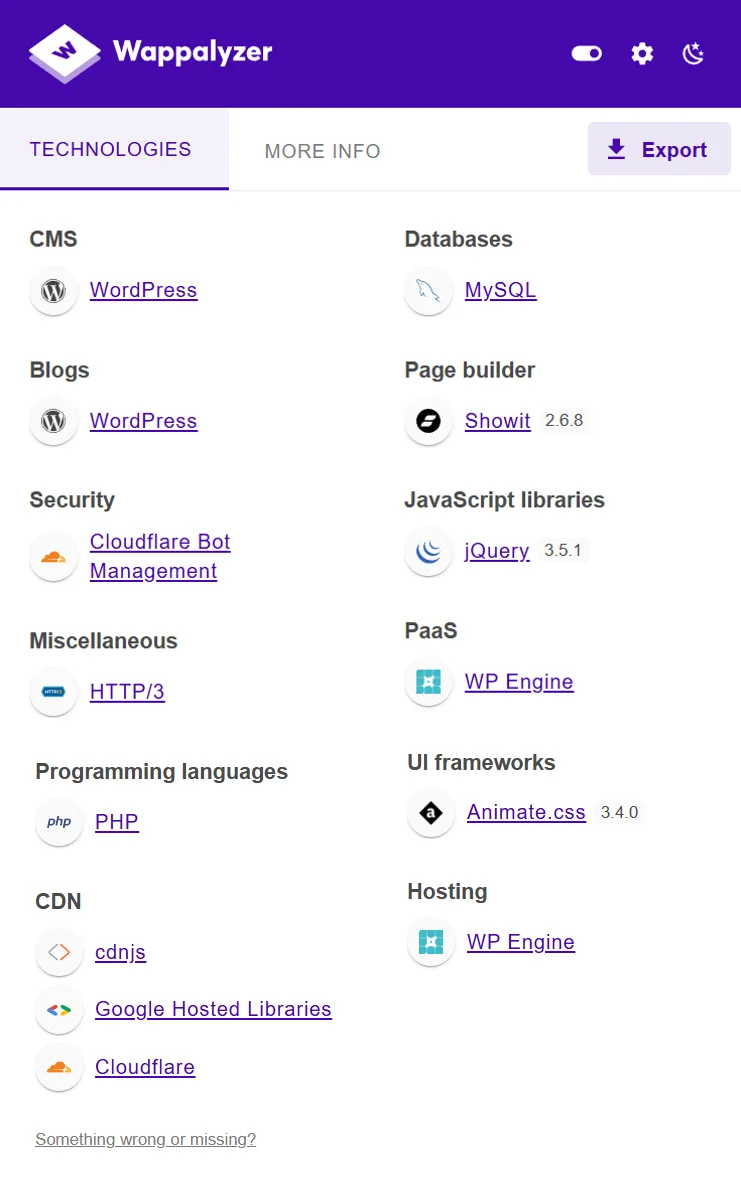 Tech stack captured via Wappalyzer on landing page only.
Uplift runs on WordPress with Showit as their page builder, hosted on WP Engine with Cloudflare for CDN and bot management. The backend also shows MySQL, PHP, jQuery 3.5.1, Animate.css, and HTTP/3 support.
What’s working well:
- WP Engine is a premium WordPress host. It’s fast, secure, and handles updates well. This is a good choice for a small business that doesn’t want to worry about server management.
- Cloudflare CDN and bot management adds a meaningful performance and security layer. HTTP/3 support means faster page loads for modern browsers.
- The overall brand execution across the site is clean and consistent, which suggests whoever built the Showit templates knew what they were doing visually.
Room for improvement:
- Showit is a visual page builder designed primarily for photographers and creatives. It works, but it’s not built for lead generation or complex form logic. For a business where conversion is the entire point of the website, a platform with better native CTA tools, form builders, and A/B testing would make a significant difference.
- No visible analytics beyond basic server logs. There’s no Google Analytics, no Microsoft Clarity, no heatmapping tool. That means Uplift has no data on where visitors drop off, which pages drive enquiries, or what content parents actually engage with. Flying blind on a site that should be their most productive sales channel.
- No visible booking or scheduling integration. A Calendly or Acuity embed for trial bookings would eliminate the friction between “interested” and “booked.”
- jQuery 3.5.1 is outdated (current is 3.7+). Minor, but worth updating for security patches.
This is my take: The hosting and security foundations are solid, which is more than most tutoring centres can say. But the site is built for presentation, not conversion. Uplift’s website is a shop window when it should be a sales floor.
What Liverpool's education market looks like
digitallyLiverpool is the economic hub of South Western Sydney, with over 18,600 businesses and a population that skews young, multicultural, and educationally ambitious. The demand for quality HSC tutoring here is intense: selective schools, competitive ATAR culture, and families who invest seriously in their children’s academic outcomes.
But the digital landscape for tutoring in Liverpool is, frankly, poor across the board. Most competitors have basic websites with no clear conversion path, minimal social media presence, and zero automation. That’s both the challenge and the opportunity for Uplift: the bar is low, which means even modest digital improvements would create visible separation.
Uplift is already the most recognised tutoring brand in the Liverpool area based on their awards history and review profile. The question isn’t whether they’re the best option locally. It’s whether a parent Googling “HSC tutoring Liverpool” at 10pm on a Tuesday can find them, understand their value, and take action, all within five minutes and without picking up the phone.
Right now, the answer to that is: not easily enough.
The 5-Minute Parent Test
I’d propose a simple benchmark for any education business: The 5-Minute Parent Test. Can a new visitor land on your site, understand what you offer, see proof that it works, and book a trial, all in under five minutes, on their phone, without calling anyone?
Uplift would pass the first two steps. The brand is clear, the offering is obvious, and the proof points are real. But step three, the booking, is where the funnel leaks. And that leak is costing them the parents who research late at night, the ones who comparison-shop between three tabs, the ones who’ll go with whichever centre makes it easiest to say yes.
Key Takeaways
-
The substance is already there:
Four Local Business Awards, 1,400+ students, 95+ ATAR results, and genuinely strong Google reviews. Uplift's problem isn't credibility. It's that their digital presence undersells what they've built.
-
CTAs need to be the loudest thing on the page:
The "Book a Free Trial" button should be impossible to miss: contrasting colour, sticky positioning, placed next to social proof. Every page should have one clear next step for the visitor.
-
Basic automations would transform their growth:
Enquiry forms, post-trial email sequences, automated review requests, and a referral program. None of this requires custom development. It requires someone to set it up and turn it on.
-
Social media needs a format shift:
606 Instagram posts for 929 followers signals a content format problem, not an effort problem. Short-form video (Reels and TikTok) is where education brands win attention in 2026, especially when your audience is students and their parents.
-
Analytics are non-negotiable:
Without Google Analytics or a heatmapping tool, Uplift has no visibility into what's working and what isn't on their own website. You can't improve what you can't measure.
How AI closes the gap between "awarded" and "visible"
Uplift has four local business awards, 1,400 students coached, and a 95+ ATAR track record. The problem isn't the teaching. It's that almost none of that evidence, voice, or method is captured in a form the business can reuse, or that an AI can amplify.
Generative AI can draft parent emails, write subject-specific content, reply to enquiries, and automate follow-ups. It writes and responds well. What it doesn't have is your tutors, your results, your curriculum, or your voice.
That's what we do at jopy.agency. We audit the business and produce structured files: Brand-Positioning.md, Service-Blueprint.md, Customer-Journey.md, Content-Framework.md (to name a few).
What are Structured .md files?
Markdown (.md) is the cleanest and smallest file format that AI likes to read.
We audit businesses end to end, your operations, workflows, brand, customers, tech, etc., then write all of it into structured .md files.
Then you can use these structured .md files so ChatGPT, Claude, Gemini, or any chat-based LLM can read your business context properly for future, in-house vertical growth.
You can then use AI in-house for enquiries, parent comms, subject content, lead follow-ups, or whatever matters most to your week.
Interested in AI Context Auditing? Visit Jopy.agencyInterested in AI Context Auditing?Cite This Article
APA 7THReferences
Formatted in APA 7th Edition
- Uplift Education. (2026). About Us. Uplift Education. https://uplifteducation.edu.au/
- The Australian Local Business Awards. (2021). Uplift Education Awards History. The Business Awards. https://thebusinessawards.com.au/business/36145/Uplift-Education-
- Australian Tutoring Association. (2026). Uplift Education Member Profile. ATA. https://ata.edu.au/job/uplift-education/
- Liverpool Chamber of Commerce & Industry. (2020). Uplift Education Member Listing. Liverpool Chamber. https://liverpoolchamber.org.au/member/uplift-education/
- Liverpool City Council. (2022). Mayor Mannoun congratulates Local Business Award winners. Liverpool City Council. https://www.liverpool.nsw.gov.au/
- Uplift Education Australia. (2026). Instagram Profile. Instagram. https://www.instagram.com/uplifteducationaustralia/