The biggest industrial estate in the Southern Hemisphere runs on handshakes and spreadsheets
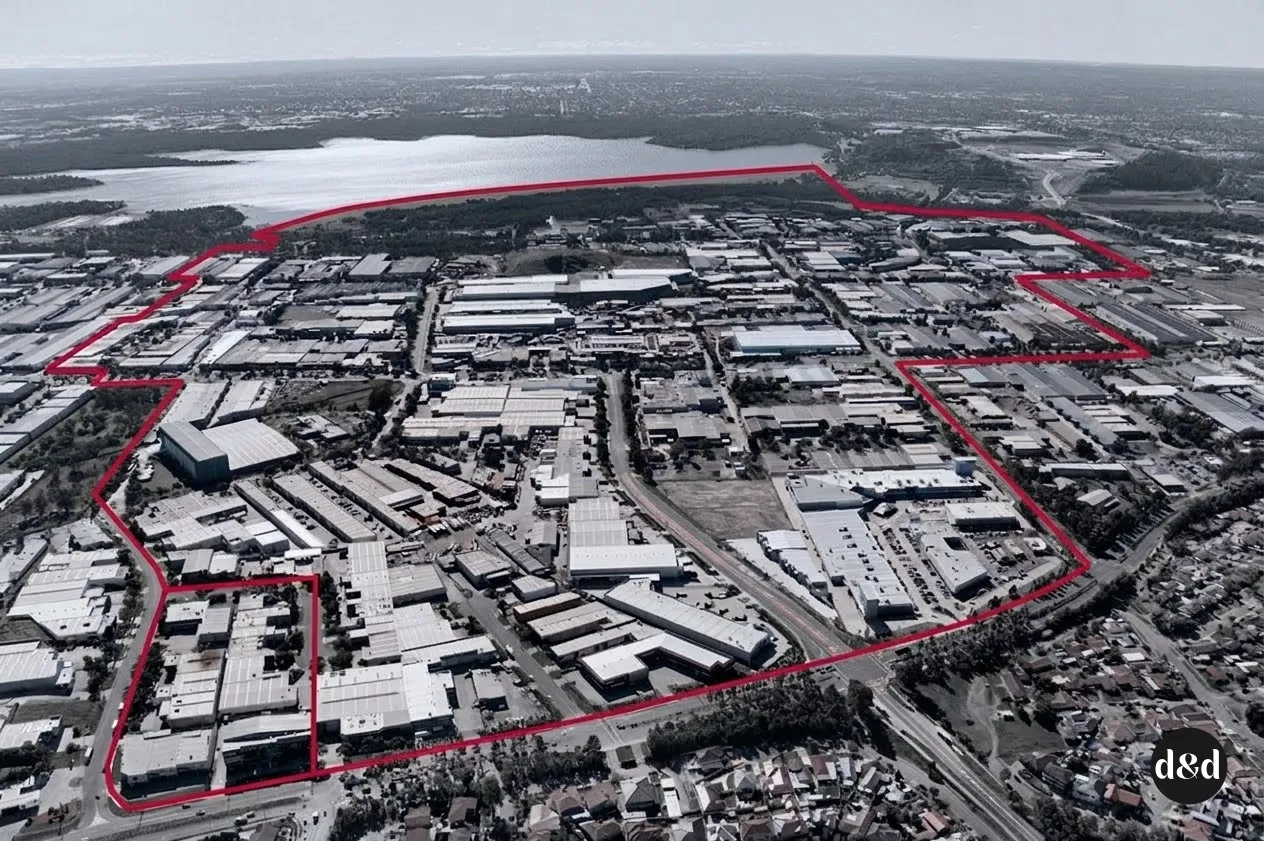
The Smithfield-Wetherill Park Industrial Estate sprawls across the City of Fairfield in Western Sydney: nearly 3,000 businesses, roughly 20,000 workers, and one of the largest concentrations of manufacturing, warehousing, and logistics operations in the Southern Hemisphere.
Companies like Jaguar, BMW, Subaru, Mercedes-Benz, and ABC Tissue Products (the people behind Quilton) operate out of here. It’s connected to the M4 and M7 motorways. It’s the distribution backbone for a significant portion of what Sydney consumes.
And most of the businesses inside it have no website, no digital supply chain tools, no online presence beyond a Google Maps pin and maybe a phone number on a faded sign out front.
They’ve survived, and many have thrived, for decades on relationships, repeat contracts, word of mouth, and the kind of trust that comes from showing up at the same unit on the same street for 30 years. That model has worked. The question is whether it keeps working after October 2026, when Western Sydney International Airport opens its doors 30 minutes down the road.
What the airport actually changes
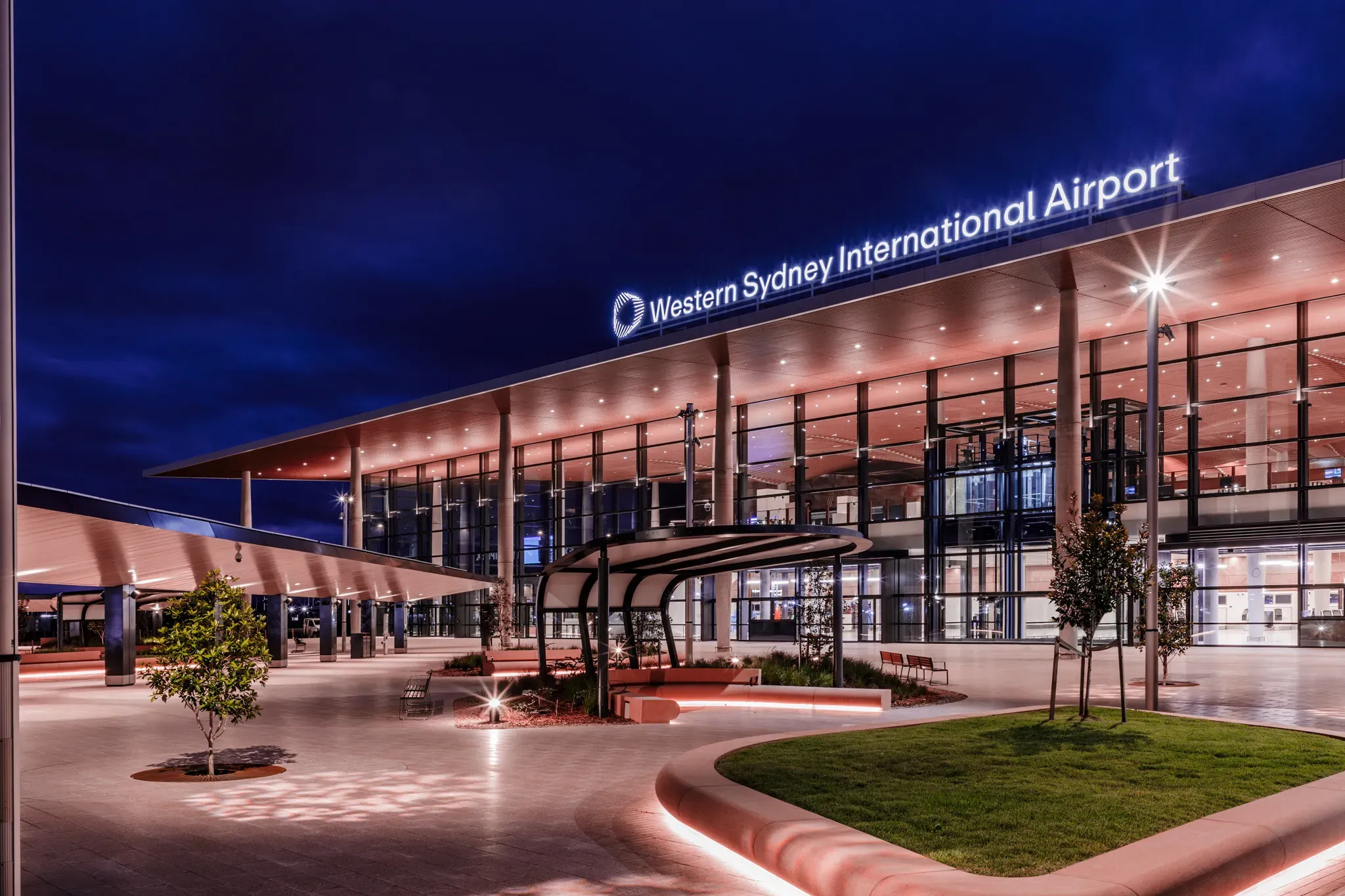 Western Sydney International (Nancy-Bird Walton) Airport. Cargo flights begin July 2026. Passenger flights from October 2026. 24/7, curfew-free operations with Singapore Airlines, Qantas, Air New Zealand, and Jetstar confirmed as launch partners.
Western Sydney International (Nancy-Bird Walton) Airport isn’t just another runway. It’s a $5.3 billion infrastructure project that fundamentally reshapes the logistics geography of Greater Sydney.
Cargo flights begin in July 2026. Passenger flights launch in October, with Singapore Airlines, Qantas, Air New Zealand, and Jetstar confirmed as opening airline partners. The airport operates 24 hours a day, 7 days a week, with no curfew, something Sydney’s Kingsford Smith Airport has never been able to offer.
The cargo precinct alone covers 75,000 square metres with eight wide-body aircraft stands. Qantas Freight and Menzies Aviation will operate dedicated cargo terminals. The new M12 Motorway provides a direct, toll-free link from the M7 to the airport. By 2030, the airport is forecast to add over 200 extra flights per day to Sydney’s aviation capacity.
For the Smithfield-Wetherill Park estate, this creates two simultaneous forces:
The opportunity: International air freight capacity 30 minutes from the precinct. Manufacturers and wholesalers who currently ship via Port Botany or Kingsford Smith’s limited cargo windows suddenly have 24/7 access to an international freight gateway. For businesses that export, or that could export, this is transformative.
The threat: That same connectivity works in reverse. Better-capitalised, more digitally sophisticated logistics operators will move into the Western Sydney corridor specifically because of the airport. They’ll bring warehouse management systems, real-time fleet tracking, automated inventory, and proper digital sales channels. They’ll compete for the same contracts, the same warehouse space, and the same customers that the current tenants serve.
The businesses that digitise will capture the new wave. The ones that don’t will get squeezed out by operators who can offer faster quotes, better tracking, and the kind of digital transparency that supply chain clients increasingly expect.
The airport doesn't just bring opportunity to Smithfield-Wetherill Park. It brings better-capitalised, more digitally sophisticated competitors into the same corridor. For a precinct of 3,000 businesses with virtually no collective digital presence, the question isn't whether to invest in digital infrastructure. It's whether they do it before October, or watch the new arrivals do it for them.
The fragmentation problem
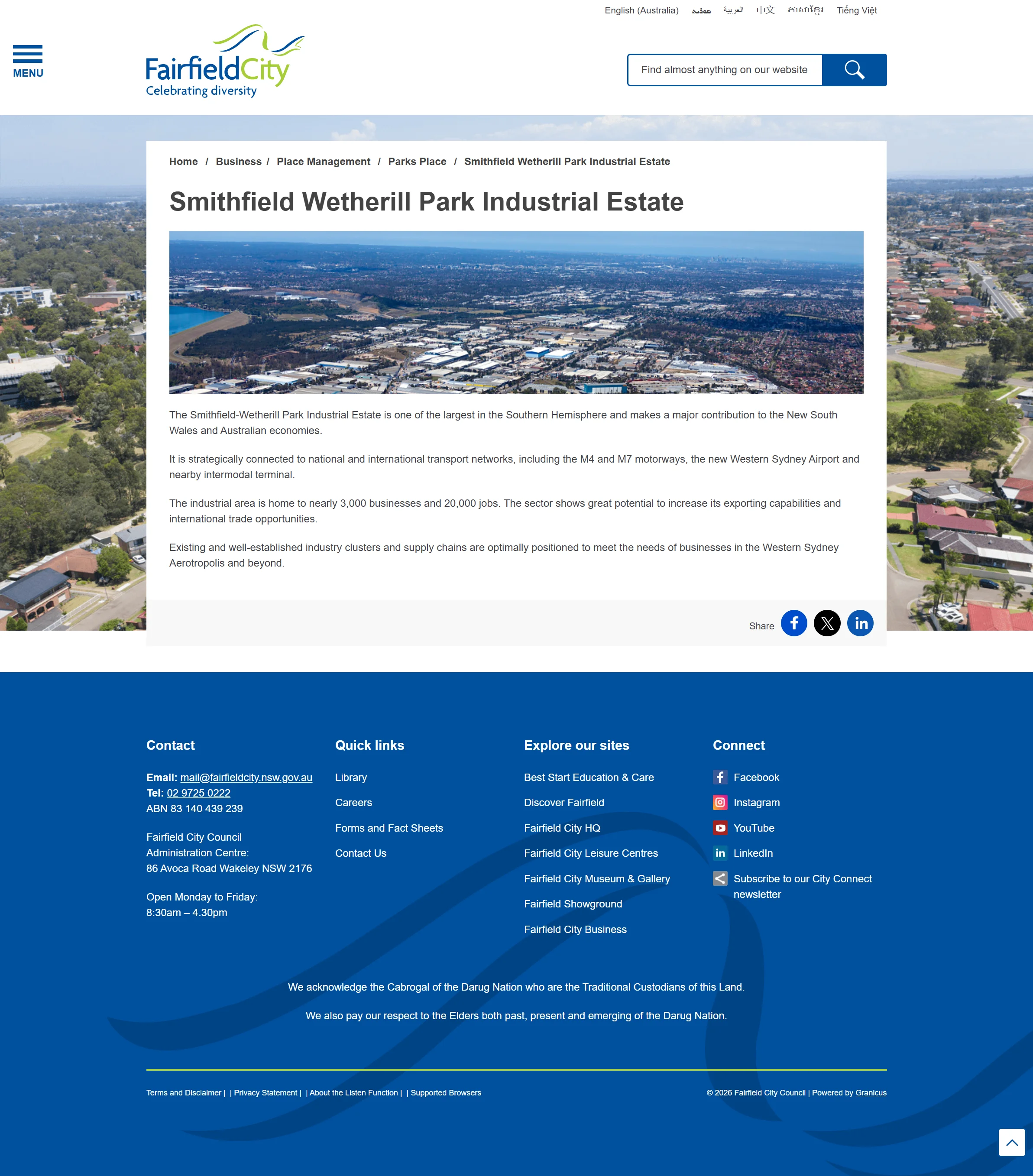 The Fairfield City Council’s page on the Smithfield-Wetherill Park Industrial Estate. This is essentially the only centralised resource that describes the precinct to the outside world. Four paragraphs, an aerial photo, and social sharing buttons. For one of the largest industrial estates in the Southern Hemisphere.
This is perhaps the most striking thing about the precinct: there is no centralised digital presence that represents it. No interactive business directory. No integrated Google Maps view showing what’s where. No investment prospectus or tenant showcase. No data on vacancy rates, transport links, or industry clusters. The Fairfield City Council page on the estate is four paragraphs of text and a photo. That’s it.
The only dedicated real estate entity I could find that focuses specifically on this area is Wetherill Park Industrial Real Estate Pty Ltd, which has a basic website and a modest Instagram presence (417 followers). Beyond that, the precinct’s 3,000 businesses are essentially invisible as a collective.
Compare this to how other industrial precincts market themselves globally. Rotterdam’s Port & Logistics cluster has a dedicated digital platform showcasing every logistics operator, transport connection, and investment opportunity. Singapore’s Jurong Industrial Estate provides interactive maps, tenant directories, and detailed industry cluster data. Even domestically, precincts like Melbourne’s Western Industrial Precinct have produced consolidated investment cases with interactive mapping.
Smithfield-Wetherill Park has none of this. And with the airport about to make Western Sydney one of the most strategically important logistics corridors in Australia, the absence of a unified digital pitch to investors, airlines, and incoming operators is a serious gap. Nobody is making the case. Not digitally, anyway.
The businesses that don’t exist online
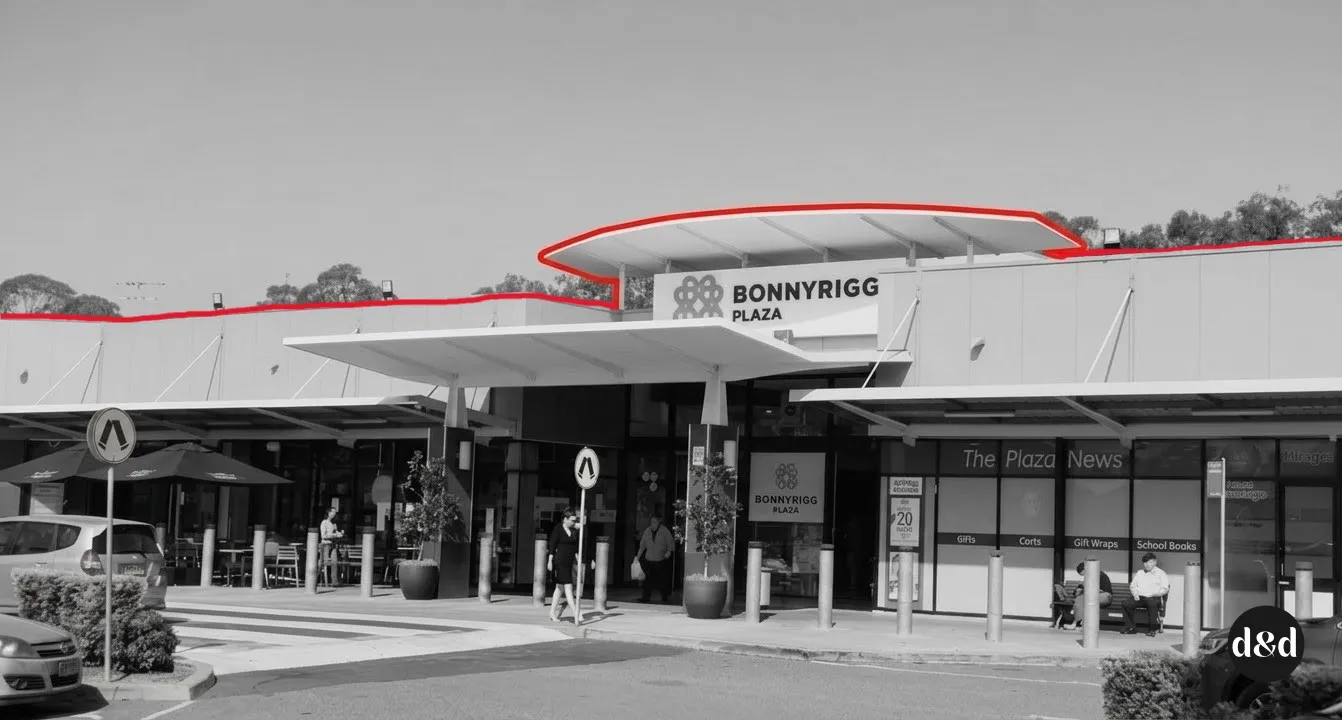
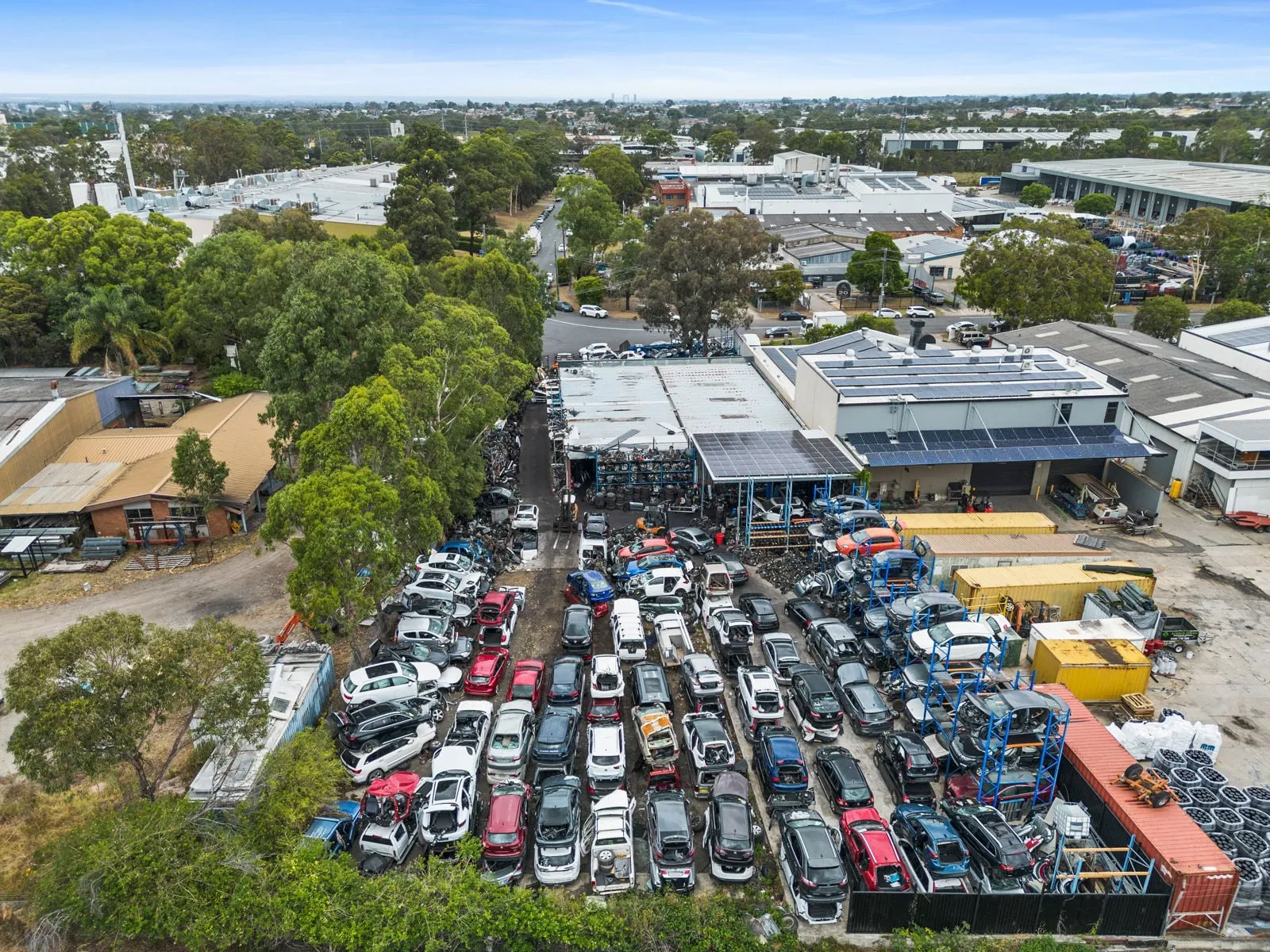 A typical scene in the Smithfield-Wetherill Park precinct: operational, busy, and completely invisible online. Many established businesses in this estate have zero digital presence beyond a Google Maps listing.
Consider a business like IDL Chemicals, a Wetherill Park manufacturer of commercial-grade disinfectants and cleaning products that’s been operating since 1958. They service hospitality, medical, correctional, and primary production sectors. They’re recognised as a Quality Endorsed Company by JAS-ANZ. They’ve been at this for nearly 70 years.
Try finding them online and you’ll struggle. Their digital footprint is minimal, consisting mostly of third-party directory listings and a recent business-for-sale advertisement. A B2B manufacturer with JAS-ANZ accreditation and nearly seven decades of operating history, and you’d barely know they exist unless someone gave you their phone number.
Or take KES (Kitchen Equipment Solutions) Stainless, a custom stainless steel fabricator in Wetherill Park that designs and manufactures commercial kitchen equipment for clients across Australia and Southeast Asia. Established in 2004 with a 1,000-square-metre facility. Their presence? A basic directory listing. No portfolio. No project gallery. No digital inquiry flow.
These aren’t failing businesses. They’re established operators with real clients, real capability, and real revenue. But they have no digital handshake.
When a new logistics operator lands at Western Sydney International and starts looking for local suppliers, manufacturers, or warehouse services, these businesses won’t appear in any search. They won’t be in any directory. They won’t have a website to send a procurement team to.
The relationship-based model that served them for decades simply doesn’t scale when the competition pool suddenly expands from “people who know someone in the estate” to “anyone with an internet connection and a freight contract.”
The AI and import risk nobody's talking about
Peter’s take on this is worth stating directly: the airport is a two-way door.
The assumption is that Western Sydney International will boost exports and attract investment into the precinct. And it will, for businesses positioned to capture that.
But the same 24/7 freight capacity that lets a Wetherill Park manufacturer ship internationally also lets an overseas competitor ship in. If a Vietnamese or Chinese manufacturer can deliver the same product at a lower cost, with a better website, clearer specifications, and an online ordering system, the airport makes it easier for Australian buyers to bypass local suppliers entirely.
This isn’t hypothetical. It’s already happening in manufacturing sectors where digital procurement platforms let buyers compare suppliers globally in minutes. The businesses that have no online catalogue, no digital quote system, and no web presence aren’t just missing out on new opportunities. They’re becoming invisible in procurement processes that increasingly start with a Google search, not a phone call.
Add AI-powered procurement tools to the mix, where algorithms scan supplier databases, compare pricing, check compliance, and generate shortlists automatically, and you have a future where businesses without structured digital data simply don’t exist in the eyes of the systems making purchasing decisions.
What “digitising” actually means for this precinct
When people say industrial businesses need to “digitise,” it often sounds vague and expensive. For the businesses in Smithfield-Wetherill Park, it’s actually quite specific:
For manufacturers: A website with a product catalogue, specifications, and a quote request form. Integration with industry directories. A basic CRM to track enquiries. If you’re exporting, multilingual product information and compliance documentation available online.
For 3PL and logistics operators: Real-time fleet tracking (even basic GPS tracking is better than nothing). A warehouse management system, even a lightweight one. Digital proof of delivery. An online portal where clients can check shipment status.
For wholesalers: An online product catalogue with pricing tiers. A digital ordering system, even if it’s just a properly built form that feeds into existing processes. SEO-optimised product pages so buyers can find you through search.
For the precinct as a whole: A centralised digital platform, something like a “Smithfield-Wetherill Park Industrial Hub,” that maps every business, categorises them by industry, links to their websites, and presents the estate as a coordinated logistics ecosystem. Integrate Google Maps. Show proximity to the airport, M4, M7, and intermodal terminals. Provide vacancy data and investment cases. Make it easy for an incoming airline cargo manager to see what’s available within 30 minutes of their new base.
None of this is speculative technology. Every tool mentioned here exists, is affordable, and is being used by competitors in other precincts right now. The question for Smithfield-Wetherill Park isn’t whether to invest. It’s how quickly, before the airport’s opening creates a competitive reset that favours the digitally prepared.
The centralisation gap
This is my take: The single biggest thing missing from this precinct isn’t any individual business’s website. It’s the absence of a centralised digital identity.
Nobody is telling the story of Smithfield-Wetherill Park as a place to invest, operate, or partner with. The Fairfield City Council page is a starting point, but it’s four paragraphs on a government website. There’s no equivalent of a “Choose Smithfield” or “Invest Western Sydney Industrial” platform that aggregates the precinct’s data, maps its businesses, and makes the case to the new class of operators arriving with the airport.
This is a precinct with 3,000 businesses, 20,000 workers, and proximity to a $5.3 billion international airport. It should have a digital presence that reflects that scale. Right now, it has a few paragraphs and a phone number.
Key Takeaways
-
The airport is a two-way door:
Western Sydney International opens in October 2026 with 24/7 cargo and passenger operations. It creates export opportunities for digitised businesses and import competition for everyone else. The precinct's survival depends on which side of that door its businesses stand on.
-
3,000 businesses, virtually no collective digital presence:
There is no centralised platform, interactive directory, or digital investment case for one of the largest industrial estates in the Southern Hemisphere. Incoming operators and investors have no easy way to discover what's already here.
-
Digitising isn't optional anymore:
For manufacturers, that means product catalogues and online quote systems. For logistics operators, it means fleet tracking and client portals. For wholesalers, it means digital ordering. For all of them, it means existing on the internet beyond a Google Maps pin.
-
AI procurement will accelerate the divide:
Procurement systems that scan digital supplier databases and compare options automatically are already here. Businesses without structured digital data won't appear in those searches. They become invisible to the systems making purchasing decisions.
-
The precinct needs a digital identity:
A centralised "Smithfield-Wetherill Park Industrial Hub" platform with interactive maps, business directories, and investment data would transform how the precinct is perceived externally. The airport is the trigger. The digital infrastructure is the response.
What the airport opening means if you're still invisible
Three thousand businesses in Smithfield-Wetherill Park, twenty thousand workers, and a new international airport opening in months. A lot of the local operators have barely any digital presence. Procurement teams, logistics majors, and AI research agents all work the same way now: if you aren't in a form they can find and evaluate, you don't exist.
Generative AI can produce capability statements, draft proposals, respond to RFPs, and handle supplier comms. It already writes competent procurement material. It can't do it for you unless it knows your plant, your compliance record, and your project history.
That's what we do at jopy.agency. We audit how your operation actually runs and produce structured files: Operations-Model.md, Service-Blueprint.md, Brand-Positioning.md, Customer-Journey.md (to name a few).
What are Structured .md files?
Markdown (.md) is the cleanest and smallest file format that AI likes to read.
We audit businesses end to end, your operations, workflows, brand, customers, tech, etc., then write all of it into structured .md files.
Then you can use these structured .md files so ChatGPT, Claude, Gemini, or any chat-based LLM can read your business context properly for future, in-house vertical growth.
You can then use AI in-house for capability statements, tenders, client comms, proposal prep, or whatever wins your next contract.
Interested in AI Context Auditing? Visit Jopy.agencyInterested in AI Context Auditing?Cite This Article
APA 7THReferences
Formatted in APA 7th Edition
- Fairfield City Council. (2026). Smithfield Wetherill Park Industrial Estate. Fairfield City Council. https://www.fairfieldcity.nsw.gov.au
- Western Sydney Airport. (2026). Grow in Sydney with WSI. WSI Airport. https://wsiairport.com.au
- Australian Government. (2026). Western Sydney Airport. Department of Infrastructure. https://www.westernsydneyairport.gov.au/
- Wikipedia. (2026). Western Sydney International Airport. Wikipedia. https://en.wikipedia.org/wiki/Western_Sydney_International_Airport
- Wikipedia. (2026). Wetherill Park. Wikipedia. https://en.wikipedia.org/wiki/Wetherill_Park
- Bechtel. (2024). Western Sydney International Airport Project. Bechtel. https://www.bechtel.com
- Time Out Sydney. (2026). Sydney's new airport will start welcoming passengers from October 2026. Time Out. https://www.timeout.com/sydney
- The Urban List. (2026). Western Sydney Airport: First Passenger Flights Confirmed. The Urban List. https://www.theurbanlist.com